What is WeCom? WeCom (企业微信, literally “WeChat for enterprises”, formerly WeChat Work) is Tencent’s business app that connects your sales teams directly with your clients on WeChat. In China, client relationships are not built by email: they grow inside a WeChat conversation, most often with a sales associate met in store. As long as that conversation runs on the employee’s personal account, the brand has no control over it. WeCom was designed to solve exactly that problem.
By the end of this article, you will know what WeCom is, how it differs from WeChat and from an Official Account, which features it offers a premium brand, and how to roll it out in your stores in China.
What is WeCom?
WeCom is Tencent’s enterprise communication platform, connected to the WeChat ecosystem. It combines an internal collaboration tool (messaging, meetings, documents) with a client relationship system that lets employees talk to WeChat users from a professional interface.
Launched in April 2016, the app first targeted internal communication in Chinese companies. Its international version, long known as WeChat Work, was renamed WeCom in 2020. The turning point came in December 2019: version 3.0 introduced Customer Moments (客户朋友圈) and group chats with clients, making the tool a pillar of private traffic (私域流量) for retail. In August 2025, version 5.0 added artificial intelligence features: smart search, automatic conversation summaries and bots that answer team questions from internal documents.
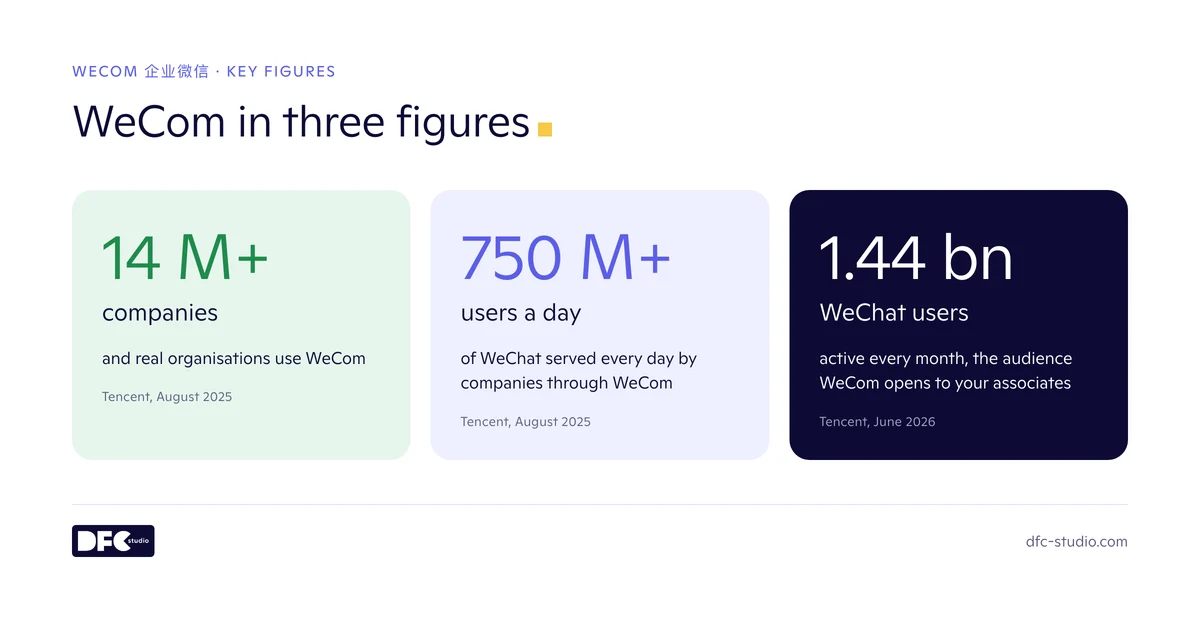
A few figures show the scale:
- More than 14 million real companies and organisations use WeCom (Tencent, August 2025).
- Through it, companies serve more than 750 million WeChat users every day (Tencent, August 2025).
- WeChat itself has 1.44 billion monthly active users (Tencent, June 2026). This is the audience WeCom puts within reach of your teams.
WeCom vs WeChat and Official Accounts: what are the differences?
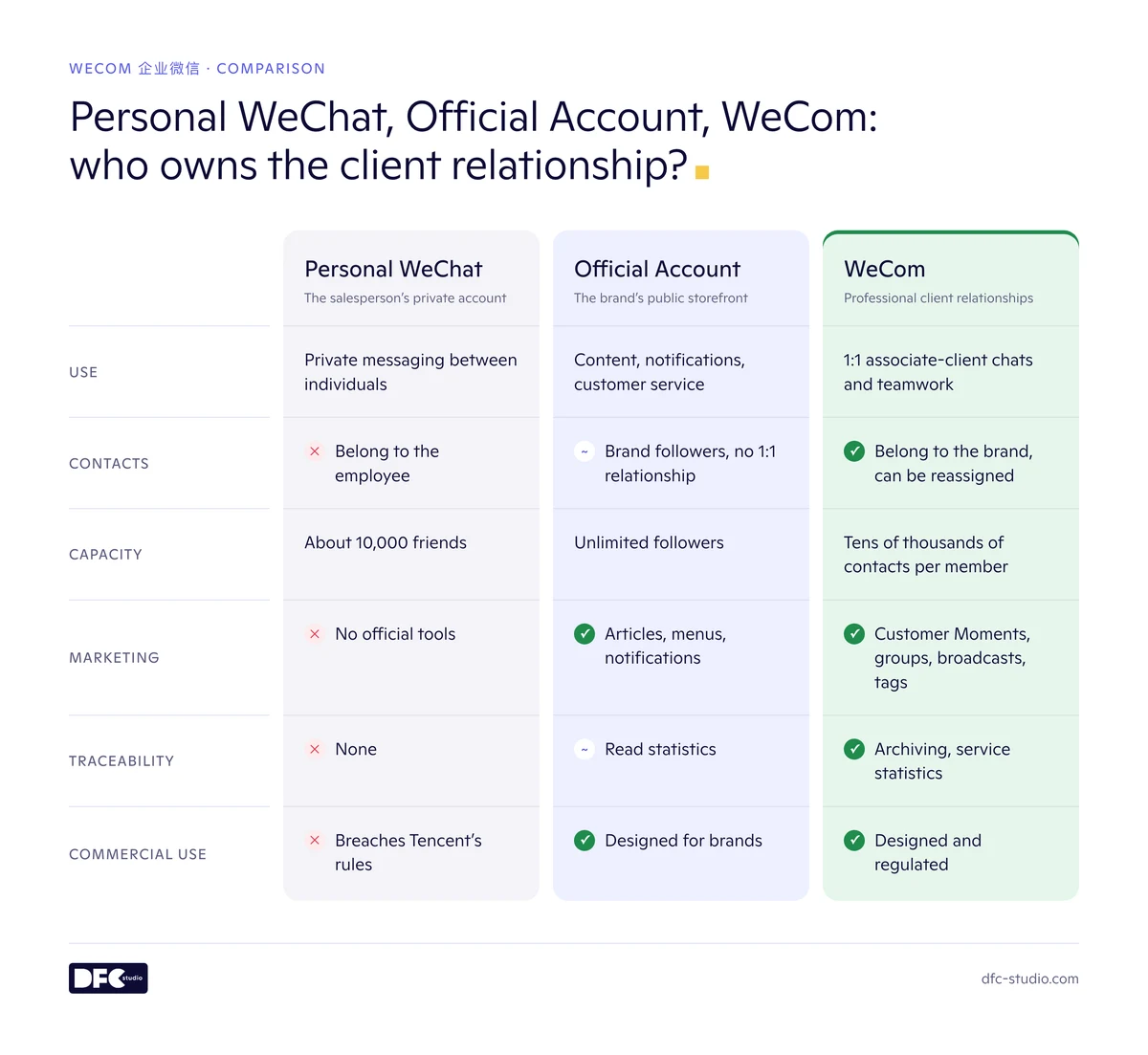
Personal WeChat, the Official Account and WeCom are three complementary tools, not substitutes. The Official Account is your public storefront, personal WeChat is a private tool that many sales staff use for work anyway, and WeCom is the professional channel that secures the client relationship in the brand’s name.
| Criterion | Personal WeChat | WeChat Official Account | WeCom |
|---|---|---|---|
| Use | Private messaging between individuals | Content, notifications, customer service, menu to a Mini Program | Internal collaboration and professional client relationships |
| Who owns the contacts | The employee, on a private account | The brand (followers) | The brand, with reassignment possible |
| Contact limit | About 10,000 friends | Unlimited followers | Tens of thousands of external contacts per member (verified account) |
| Marketing features | No official features | Articles, notifications, custom menus | Customer Moments, client groups, targeted broadcasts, tags |
| Traceability | None | Read statistics | Conversation archiving (paid option), service statistics |
| Compliance | Commercial use breaches Tencent’s terms | Designed for brands | Designed for regulated commercial use |
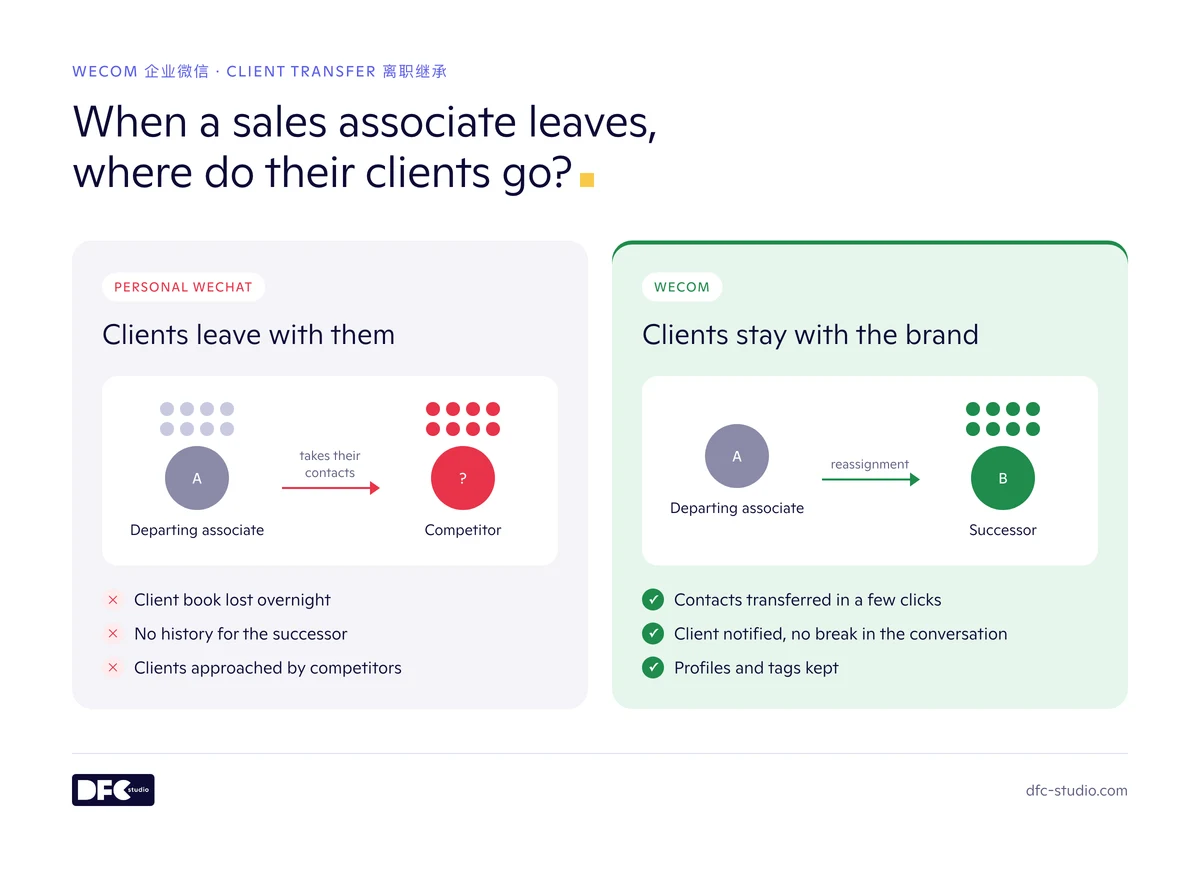
The key message: with WeCom, the client relationship belongs to the brand, not to the salesperson. When an associate leaves, their client book stays in the company and passes to their successor. With personal WeChat, it leaves with them, often to a competitor.
Why WeCom has become essential for premium brands in China
WeCom has become standard equipment in Chinese retail because it answers three market shifts at once: rising acquisition costs on public platforms, the central role of one-to-one relationships in premium purchases, and the risk of losing clients through personal WeChat accounts.
Private traffic versus rising acquisition costs. Buying traffic on Tmall, Douyin or Tencent’s ad network gets more expensive every year, and the client you acquire still belongs to the platform. Private traffic (私域流量) reverses the logic: once a client is added on WeCom, the brand can reach them again without paying for access.
Personalised service, the heart of premium in China. Chinese high-end clients expect clienteling: a named associate, recommendations based on their history, early access to new products. WeCom turns this into a system: client tags, detailed profiles, birthday messages, targeted invitations. What an outstanding salesperson once did from memory for thirty clients, the brand can now organise for thirty thousand.
The real risk of a departing salesperson. In Chinese retail, it is common for a sales associate to have several hundred clients on their personal WeChat. Their departure, frequent in a high-turnover sector, wipes out overnight a commercial asset built at the brand’s expense. WeCom removes this risk by design: contacts belong to the company and can be reassigned in a few clicks.
Key WeCom features for a brand
WeCom covers the whole client relationship cycle: acquiring the contact, engagement, conversion and loyalty. Five features deserve a premium brand’s attention.
Client contact and WeChat interconnection
A sales associate adds a client met in store through a QR code: the client receives the conversation in their personal WeChat without installing anything. The associate works in WeCom, with a client profile, tags (city, favourite category, date of last purchase) and an automatic welcome message. For a premium brand, this guarantees that every store contact joins a central asset instead of staying on a private phone.
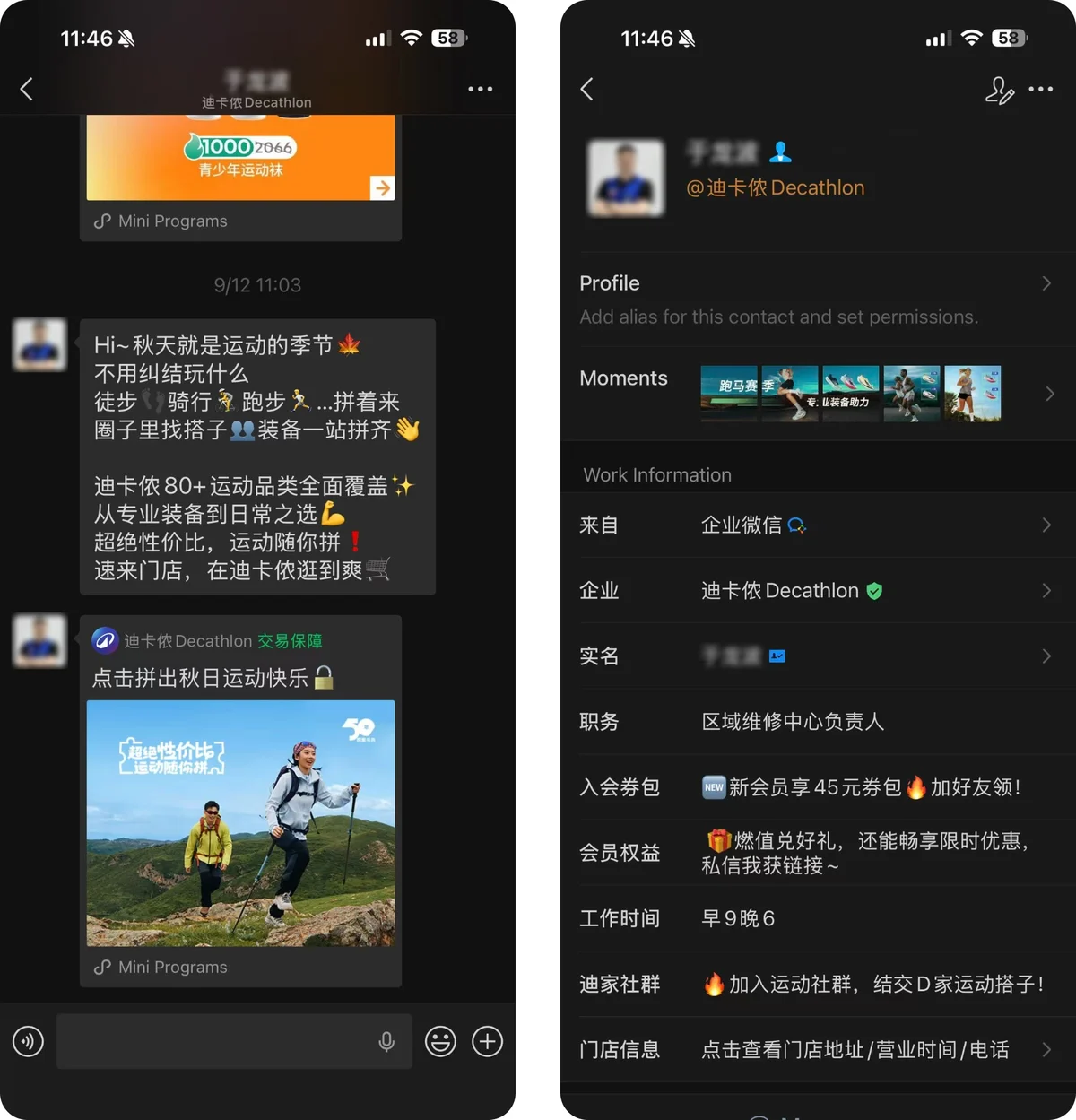
This first contact needs structure. A typical welcome journey chains the welcome message, a first useful piece of content in the following days (care advice, a collection preview), then a personal invitation. Tags work best when headquarters defines them as categories shared by all stores (profile, interests, purchase history, relationship level), so the data stays usable from one associate to the next.
Customer Moments (客户朋友圈)
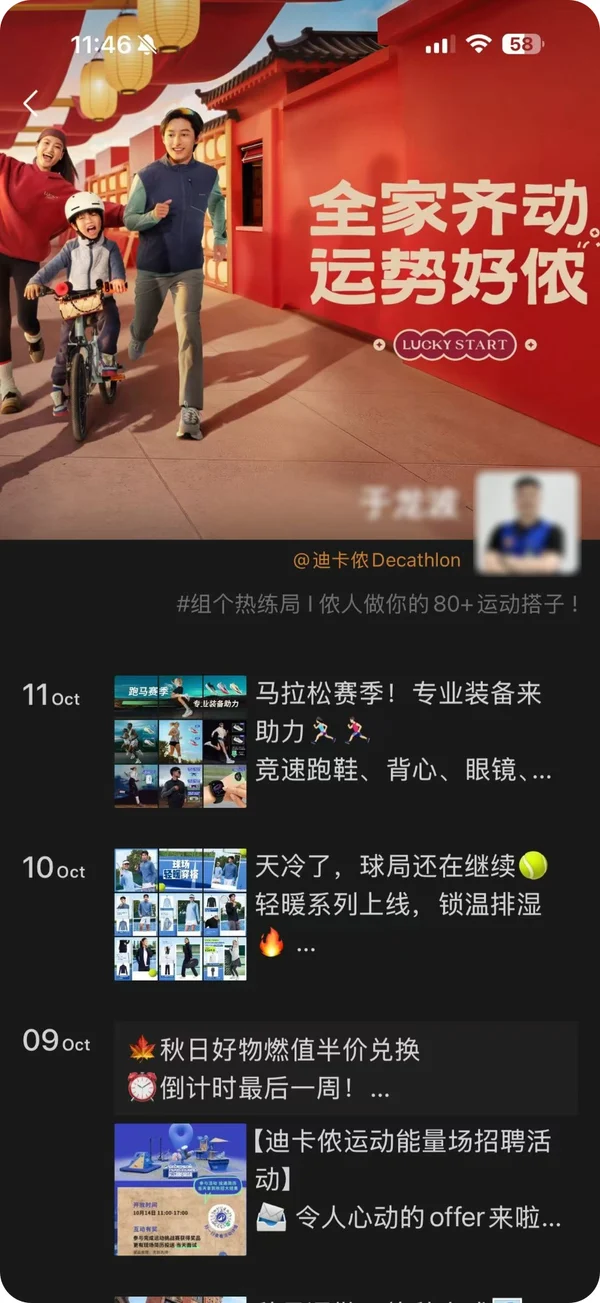
Customer Moments let you publish content that appears in the client’s Moments feed, in the company’s name rather than an individual’s. The brand can push a visual prepared centrally or let each associate post. Tencent caps the number of posts a client can receive from the same member, and the company cannot see the client’s personal Moments. Publishing statistics help manage the quality of the programme.
Client groups and broadcasts
Client groups gather up to several hundred members around a store or a theme: a capsule collection, a loyalty club, fans of a vintage. Automatic welcome messages, anti-spam rules and group announcements make them a regular engagement channel. The broadcast feature (群发) sends a targeted message to segments defined by tags, within the frequency limits set by Tencent.
Conversation archiving and client transfer
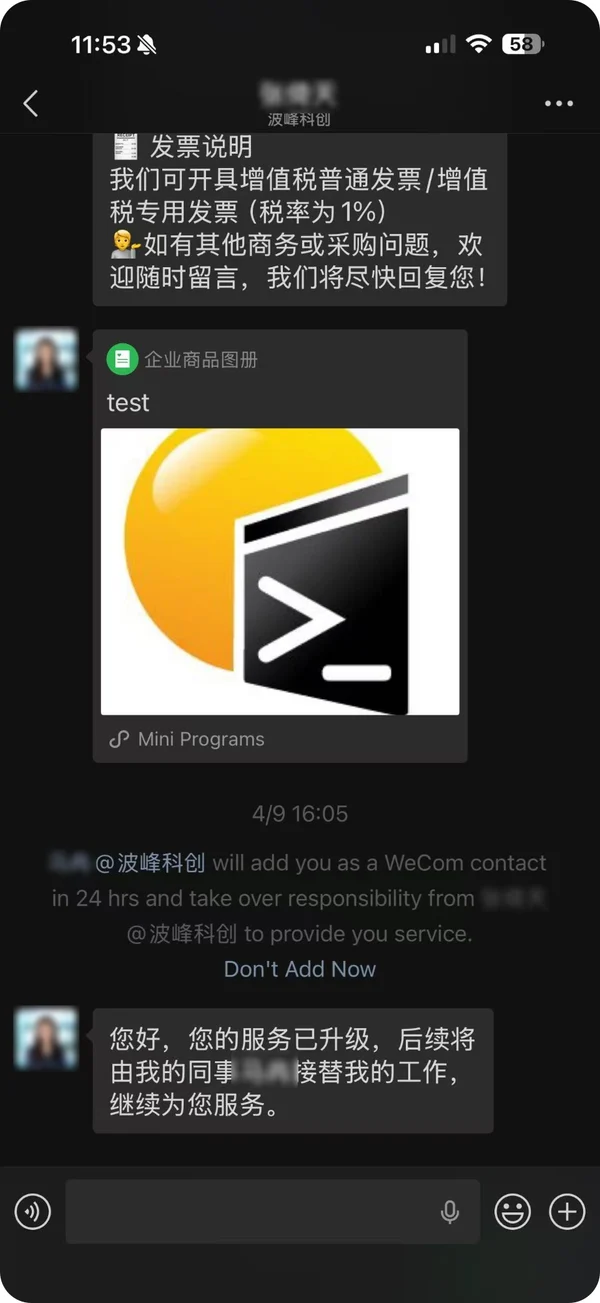
Conversation archiving (会话内容存档) keeps, with the client’s consent, the history of exchanges between associates and clients. This paid option, billed by the number of accounts equipped, supports compliance, team training and continuity of service. Client transfer (离职继承) completes the system: when an employee leaves, their contacts are reassigned to a colleague and the client is notified.
Integrations: Mini Program, CRM, automation (API)
WeCom connects to the rest of the ecosystem: an associate can share a product page from your Mini Program, take payment through WeChat Pay, or direct a client to after-sales service. Open APIs sync contacts, tags and history with your CRM or marketing automation tool. WeChat Customer Service (微信客服) also plugs into your existing contact centre.
Payments. Linking WeCom to the company’s WeChat Pay account ends a common and risky practice: the associate who collects payment on their personal WeChat before passing the money on. Payment goes straight to the brand, and store managers track orders, returns and refunds from the console.
Data architecture. A successful integration relies on a unique ID per client, usually their mobile number, collected from the first exchange. To comply with PIPL, international brands generally keep personal data in a CRM hosted in China (Salesforce China, or local client relationship tools such as Weimob and Youzan), and only send aggregated or anonymised data to the headquarters CRM.
How to bring clients onto WeCom: the entry points
A WeCom programme is only worth the number of clients who join it. The store remains the first source of contacts, but a premium brand has at least six other entry points that move the client from the public audience (advertising, social media) to a private relationship with an associate.
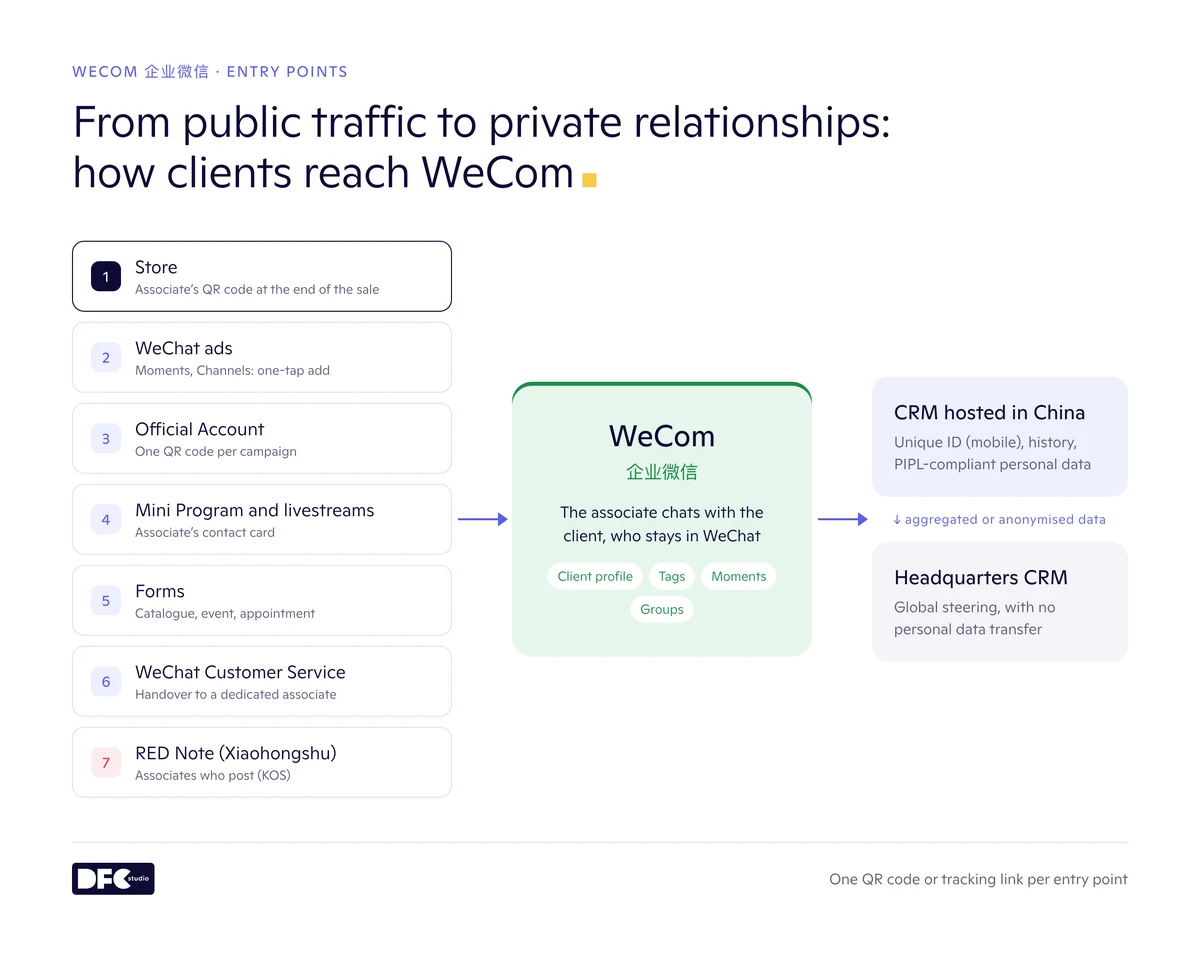
- WeChat advertising. Ads in Moments or in WeChat Channels can offer to add an associate in one tap. It is the fastest way to turn a campaign into qualified conversations. See our guide to WeChat advertising.
- The Official Account. A QR code specific to each campaign, placed in an article or in the Official Account menu, invites followers to move from passive reading to a conversation with an associate, and shows which post generates contacts.
- Mini Program and livestreams. A product page, a booking page or a Channels livestream can display an associate’s WeCom card at the moment the client’s interest peaks.
- Forms. A catalogue request, an event registration or a tasting booking ends with an invitation to add an associate, who takes over the same day.
- Customer service. A one-off question to WeChat Customer Service becomes a lasting relationship when the agent offers to continue the conversation with a dedicated associate.
- RED Note (Xiaohongshu). Associates who post under their own name on Xiaohongshu (the KOS model, for Key Opinion Sales) attract a qualified audience, which they then invite to continue the conversation on WeCom.
Each entry point needs its own QR code or tracking link: it is the only way to know which channels bring clients who buy, not just contacts.
Practical use cases
Three scenarios show what WeCom changes depending on how you operate in China.
Scenario 1: own stores (beauty). A French cosmetics house runs three stores in Shanghai. Every client who buys is invited to add her beauty advisor on WeCom, with a complimentary treatment as an incentive. The advisor keeps the relationship alive: routine reminders, restock alerts, invitations to in-store events. Expected result: a measurable repurchase rate, a client book that survives staff departures, and structured feedback from the field to headquarters.
Scenario 2: wholesale brand (fashion). A leather goods brand sold through multi-brand retailers has no access to end clients. It rolls out WeCom across its Chinese retail team: associates in partner stores join the programme, receive content and training, and pass on client requests. Expected result: the brand rebuilds a direct relationship with its clients without bypassing its distributor, and finally manages the quality of the in-store pitch.
Scenario 3: wine and spirits. A cognac house runs a community of collectors: client groups by city, Customer Moments dedicated to limited editions, invitations to tasting dinners sent by targeted broadcast. Expected result: rare allocations sold within hours to a qualified base, with no media spend.
How to roll out WeCom: the steps
A successful WeCom rollout takes six steps, over a realistic two to three months for a first pilot store.
- Define the programme. Set the goals (loyalty, repurchase, community engagement), the teams involved and the KPIs before any technical setup.
- Create and verify the account. Registration is free and possible from abroad with a phone number outside mainland China, preferably through the official website. Verification, required to lift the caps on members and contacts, costs RMB 700 per year for a foreign company (RMB 300 per year for a Chinese entity with fewer than 1,000 members) and takes 10 to 15 working days. A Chinese entity is not required to start, but it makes some advanced features, such as payments, easier to access.
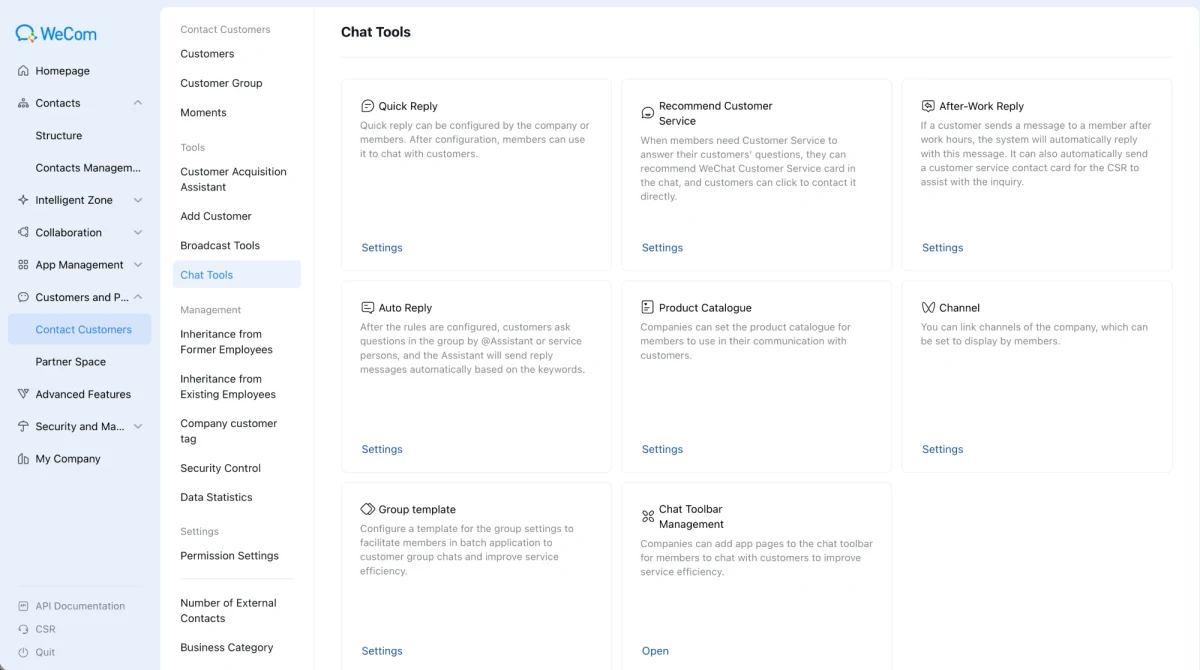
- Structure the organisation. Set up the structure, admin roles, the client tag library and the posting rules: who posts what, how often, with which approval. The admin console centralises these settings, along with the tools available to associates: quick replies, automatic replies outside working hours, product catalogue, group templates.
- Connect the tools. Link WeCom to the Mini Program and the CRM and, if needed, turn on conversation archiving and WeChat Customer Service.
- Train the store teams. Coach associates on making contact (the QR code at the end of the sale), the expected tone, the content available and the limits to respect. The project succeeds or fails at this step, not in the admin console.
- Measure and adjust. Track add, reply and conversion rates, then extend the programme store by store after a four to six-week pilot.
Limits, compliance and mistakes to avoid
WeCom is a powerful tool, but it is tightly regulated, both by Chinese law and by Tencent’s rules. Three points to watch.
PIPL (个人信息保护法). China’s Personal Information Protection Law, in force since November 2021, requires informed consent for collection, data minimisation and strict conditions for any transfer outside China. WeCom client profiles contain personal data: how you use them and sync them with a CRM hosted in Europe must be reviewed by a lawyer before rollout.
Tencent’s restrictions. The platform limits how often you can reach clients (Customer Moments seen by the same client, quotas on mass broadcasts) and moderates promotional content. Detected abuse (unsolicited mass messaging, misleading content) exposes the account to restrictions, or even suspension.
Common mistakes of European brands.
- Translating European content without rewriting it for Chinese habits and the Chinese calendar.
- Managing client relationships from Europe, without a local team able to reply the same day.
- Equipping stores without training associates or rewarding them for adding contacts.
- Collecting contacts with no engagement strategy: a dormant client book is worth nothing.
- Using mass-retail tactics. Daily red envelopes, repeated coupons and high-frequency broadcasts work for mass-market beauty, but damage a high-end brand’s image. Retailers that forced clients to add a contact at checkout and multiplied follow-ups mostly got clients who unsubscribe. For a premium brand, the rule is the opposite: fewer messages, more personal, and always a reason to send them.
FAQ
How much does WeCom cost? Is it free?
Registering and standard use of WeCom are free. Company verification, needed to go beyond about a hundred members and external contacts, costs RMB 300 per year for a Chinese entity with fewer than 1,000 members and RMB 700 per year for a foreign company. Beyond 2,000 external contacts, Tencent also charges RMB 0.1 per contact per year. Paid options include conversation archiving, extra storage and advanced admin features.
Can a foreign brand open a WeCom account?
Yes. A foreign company can create a WeCom account with a phone number outside mainland China, preferably through the official website rather than the mobile app. Verification costs RMB 700 per year and takes 10 to 15 working days. A Chinese entity is not required to start, but it makes advanced features such as payments easier to access.
What is the difference between WeCom and WeChat Work?
None: WeChat Work is the former international name of 企业微信, renamed WeCom in 2020. It is the same Tencent business app. Both names still appear in documentation and articles, which often confuses foreign brands discovering the tool.
Does WeCom replace the WeChat Official Account?
No. The Official Account remains your public storefront: brand content, notifications, a menu to your Mini Program. WeCom handles the one-to-one relationship between your associates and your clients. The two tools complement and connect to each other: an Official Account follower can be invited to add an associate on WeCom, and vice versa.
Can WeCom be connected to a CRM?
Yes. WeCom offers open APIs that sync contacts, tags and conversation history with a CRM or marketing automation tool. Chinese providers also offer ready-made connectors. A custom integration usually takes 4 to 8 weeks of development.
What happens to clients when a salesperson leaves the company?
Contacts created through WeCom belong to the company. The admin reassigns them to another associate with the client transfer feature (离职继承). The client receives a notification and continues the conversation without interruption. This is the major difference with personal WeChat, where the relationship follows the departing employee.
Do sales associates need a work phone?
No. WeCom can be installed on a personal phone as well as on a company device; it is a matter of internal policy. Because the WeCom account is separate from the associate’s personal WeChat, private life and client relationships stay apart either way. For members based outside mainland China, check Tencent’s current identity requirements.
Is WeCom available in English?
Yes. The app is available in English and Chinese, and the admin console and help centre are largely translated into English. A team at headquarters can therefore manage the account, even if conversations with clients take place in Chinese.
Is WeCom safe for a brand?
Far safer than personal WeChat. Accounts belong to the company, the admin sets each member’s rights, a watermark can discourage screenshots, and an employee’s departure is handled without losing contacts. Security still depends on the setup: access rights, offboarding procedure and internal rules must be defined before launch.
Conclusion
Three takeaways. WeCom is the channel that connects your sales associates with WeChat’s 1.44 billion users, in a professional and compliant framework. The client relationship it builds belongs to the brand: it survives staff departures and grows richer with every exchange. And rollout remains a light project: a few weeks are enough to equip a pilot store, provided you invest in team training and PIPL compliance.
Want to know whether WeCom is right for your organisation in China? Let’s spend thirty minutes on your situation: we will tell you honestly whether the tool is worth your investment. Discover our WeChat services for premium brands.
OUR EXPERTISEWeChat agency in China
Thibault has been living in Beijing since 2014 and has quickly established himself as one of the leading international digital experts in China. With his extensive expertise, he assists large corporations, institutions, and high-end brands in their digital development by offering strategic solutions tailored to the Chinese market.