In 30 seconds: WeChat (微信, Weixin in China) is Tencent’s super app, combining messaging, social media, payments, shopping and services. It had 1.439 billion monthly active users at the end of June 2026. For brands, it offers Official Accounts, Channels, Mini Programs, advertising, the WeChat store and WeCom. Since 2025, artificial intelligence has moved to the heart of the app.
What is WeChat?
WeChat is the messaging and services app developed by Tencent, launched in 2011 under the name Weixin (微信). What started as a simple messenger has become a super app: people chat, read the news, pay for groceries, book a taxi or a restaurant table and follow their favourite brands without ever leaving the app.
- 1.439 billion monthly active users at the end of June 2026, up 2% in a year (Tencent, Q2 2026 results, Weixin and WeChat combined).
- 14 million+ companies use WeCom, WeChat’s business version (Tencent, August 2025).
What sets WeChat apart from Western messaging apps is its ecosystem. Official Accounts act as websites, Mini Programs as apps, WeChat Pay as a wallet and Channels as a video network. For a brand, WeChat is not just another social network: it is often the first point of contact with Chinese clients, and sometimes the only one.
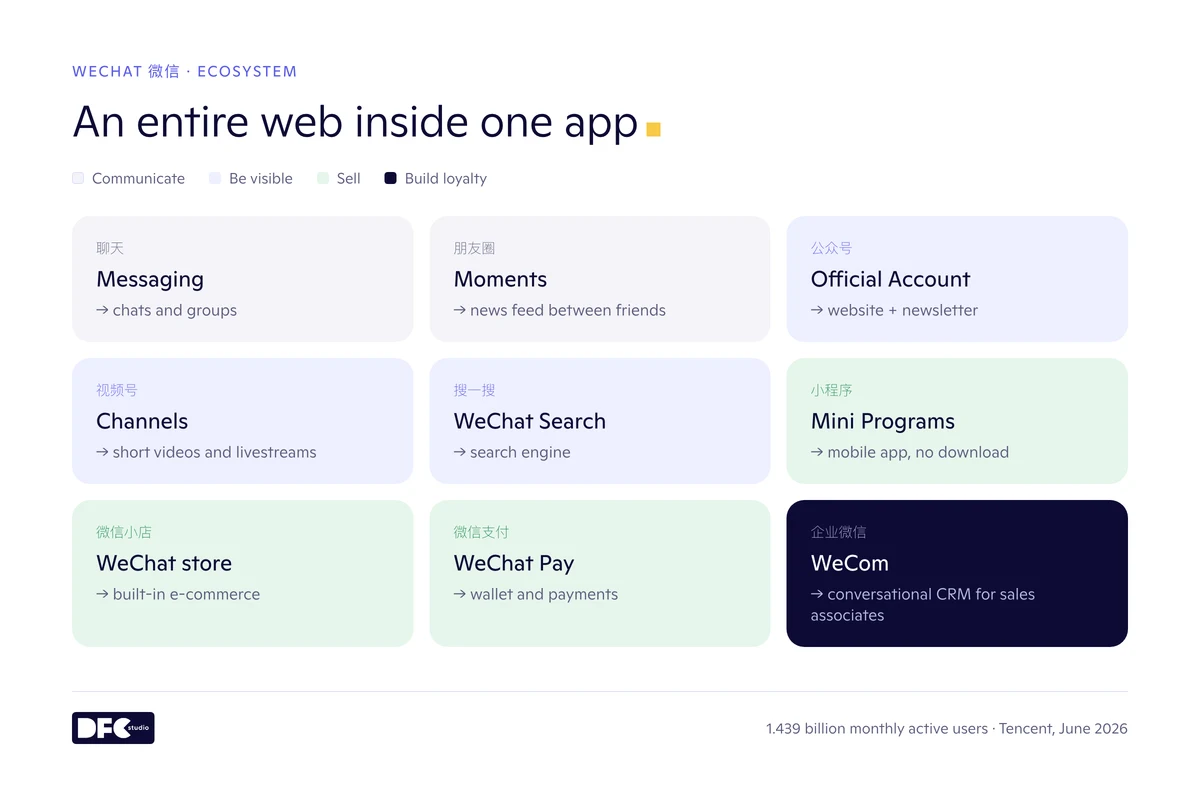
This guide covers every WeChat feature, what is new in 2025 and 2026, how to use the app outside China, and the roadmap for a brand getting started.
Growing your brand in China? Meet our WeChat agency: a Franco-Chinese team in Beijing, from strategy to campaigns.
Weixin vs WeChat: what is the difference?
Weixin and WeChat are the same app, but not quite the same service. The phone number used to sign up decides the version: a Chinese number opens a Weixin account, a foreign number a WeChat account. Tencent reports a combined user figure for both.
| Weixin (微信) | ||
|---|---|---|
| For whom | Users registered with a Chinese number | Users registered with a foreign number |
| Features | All features, including services linked to a Chinese bank account | Messaging, Moments, Official Accounts and most Mini Programs; some services remain China-only |
| Rules | Weixin terms and privacy policy, Chinese law | Separate terms and privacy policy specific to WeChat |
For a brand, the consequence is simple: your Chinese clients are on Weixin. Content, Official Accounts and Mini Programs must be designed for them, in Chinese, even if your teams outside China view them from an international WeChat account.
Messaging: chatting and sharing on WeChat
Messaging remains the heart of the app. Users chat one-to-one or in groups, by text, voice message, photo, video or file, make voice and video calls and share their location in real time.
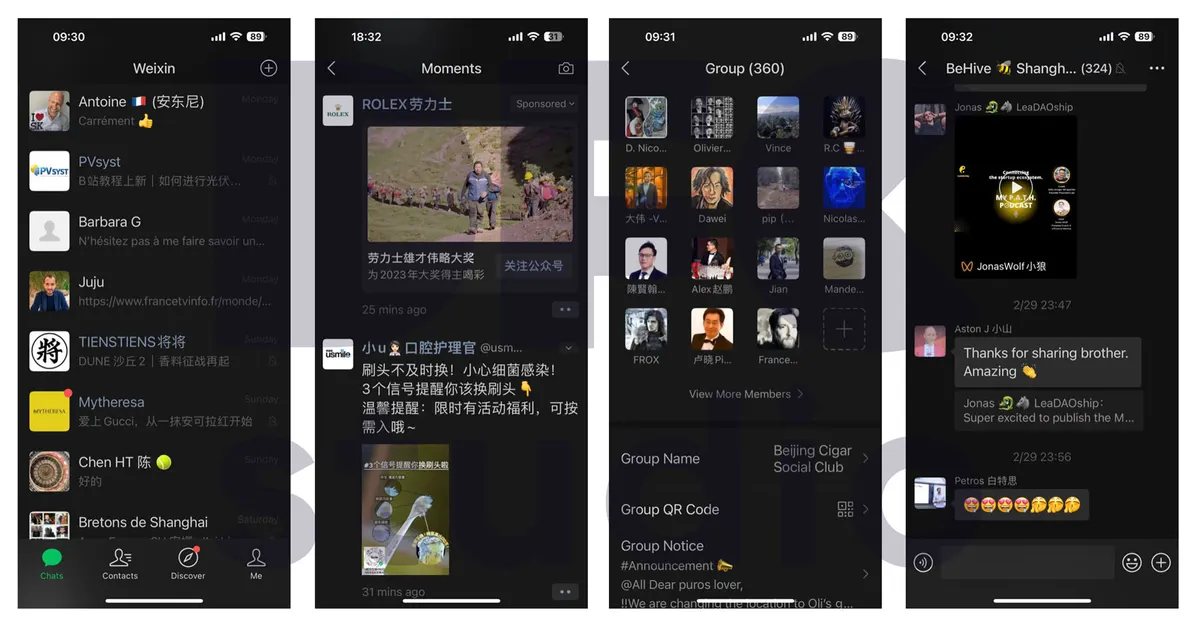
Groups shape social and professional life in China: family, colleagues, clients, school parents, fans of a brand. This is where recommendations, links to articles and Mini Programs, and often purchase decisions circulate.
Good to know: a WeChat group has up to 500 members, and a message can be recalled within two minutes of being sent.
To compare WeChat with other messaging apps used in China, read our article on messaging apps that work in China. For privacy questions, our guide Is WeChat safe? covers the essentials.
WeChat Official Accounts: using WeChat for business
The Official Account (公众号) is a brand’s storefront on WeChat, the equivalent of a website and a newsletter combined. It lets you publish articles, send notifications to followers, offer a menu to a Mini Program or a store, and provide customer service.
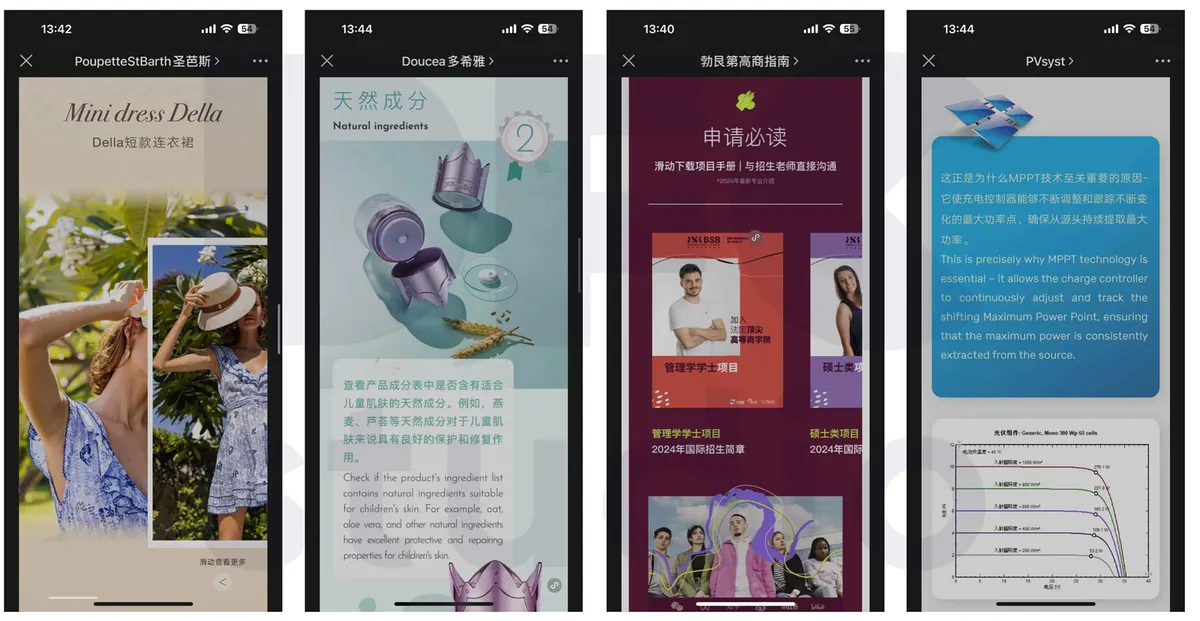
There are two types of Official Accounts, depending on your goal.
| Subscription account | Service account | |
|---|---|---|
| Best for | Media and brands that publish content often | Brands that sell or offer a service (payment, booking, customer service) |
| Broadcasts to followers | 1 per day | 4 per month |
| Articles per broadcast | Up to 8 | Up to 8 |
A foreign company can open an Official Account without a Chinese entity, with an international account. It can never be converted into a Chinese account, and some features, such as payments, require a Chinese business licence: the choice must be made from the start. See our step-by-step guide to opening a WeChat Official Account.
WeChat Channels: short videos and livestreams inside WeChat
Channels (视频号) is WeChat’s video format: short videos, livestreams and, increasingly, live selling. Its distinctive feature is its social algorithm: a video “liked” by your contacts rises in your feed. Recommendations rely as much on your circle of friends as on your interests.

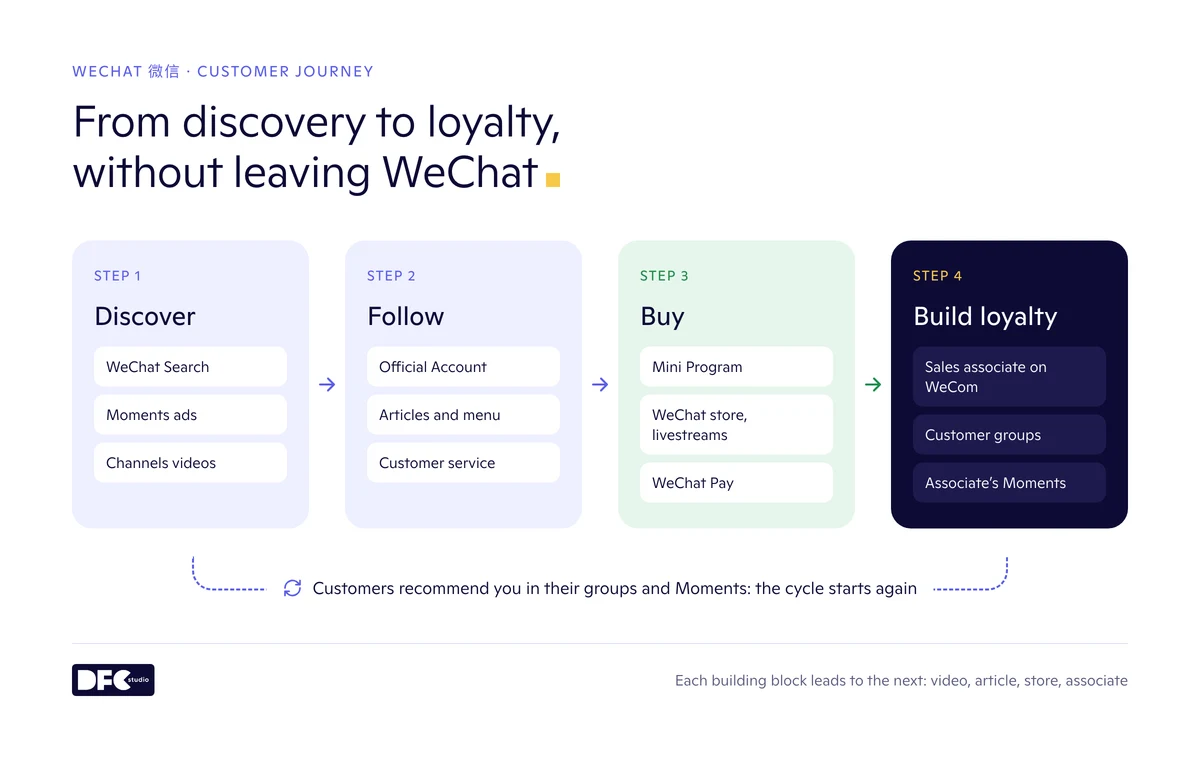
For a brand, Channels connects the whole ecosystem: a video can lead to the Official Account, a livestream can sell through the WeChat store, and an ad can offer to add a sales associate on WeCom. It is now the most direct way to gain visibility beyond your followers. Read our complete guide to WeChat Channels.
WeChat Mini Programs: apps with no download
Mini Programs (小程序) are lightweight apps that open directly in WeChat, with no installation. They cover almost every use: online store, booking, loyalty card, restaurant ordering, games, transport.
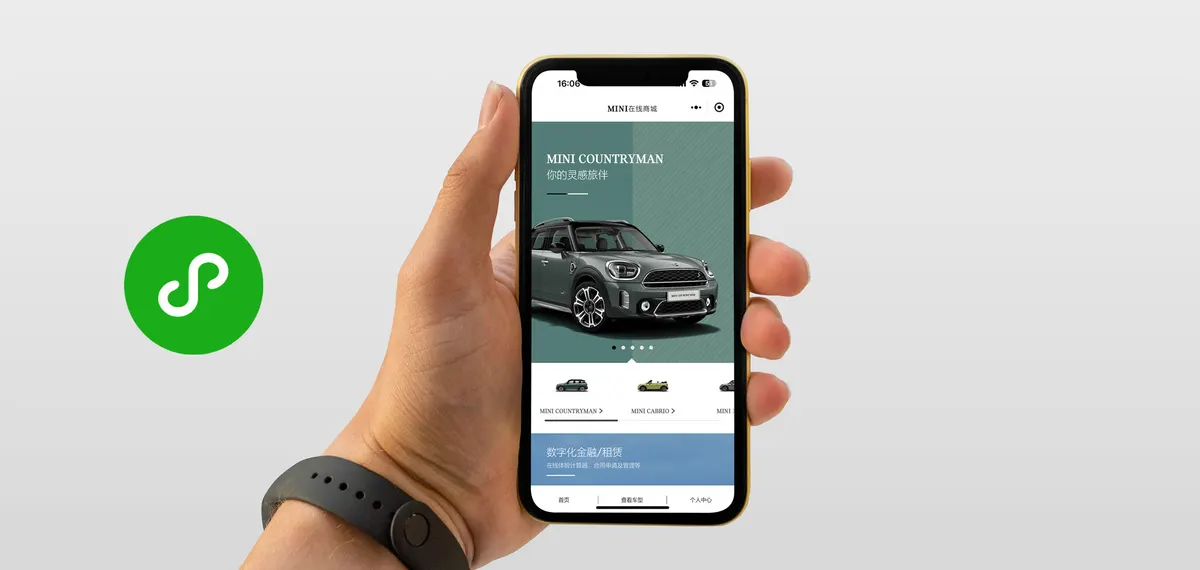
For a brand, a Mini Program often replaces the mobile app: it can be shared in a chat, opened from a QR code in store and take payments through WeChat Pay. Its main advantage is that it stays inside WeChat, where your clients already are. Read our complete guide to WeChat Mini Programs.
WeChat Pay: paying and getting paid with WeChat
WeChat Pay is the wallet built into WeChat. It is used to pay in store by scanning a QR code, to pay online and in Mini Programs, to send money to friends and family, to split a bill and to give red envelopes (红包).

From street vendors to department stores, WeChat Pay has become one of the most common ways to pay in China.
Good news for travellers: foreigners can now link an international bank card (Visa, Mastercard…) to WeChat Pay to pay in China. For brands, WeChat Pay also makes it possible to accept payments from Chinese tourists abroad, through licensed providers. Read our guides to WeChat Pay and WeChat QR codes.
WeChat Moments: the news feed between friends
Moments (朋友圈) is WeChat’s news feed: users post photos, videos, text and links that only their contacts can see. Privacy settings are detailed: a post can be limited to a group of friends, or only the last three days of posts can be shown.
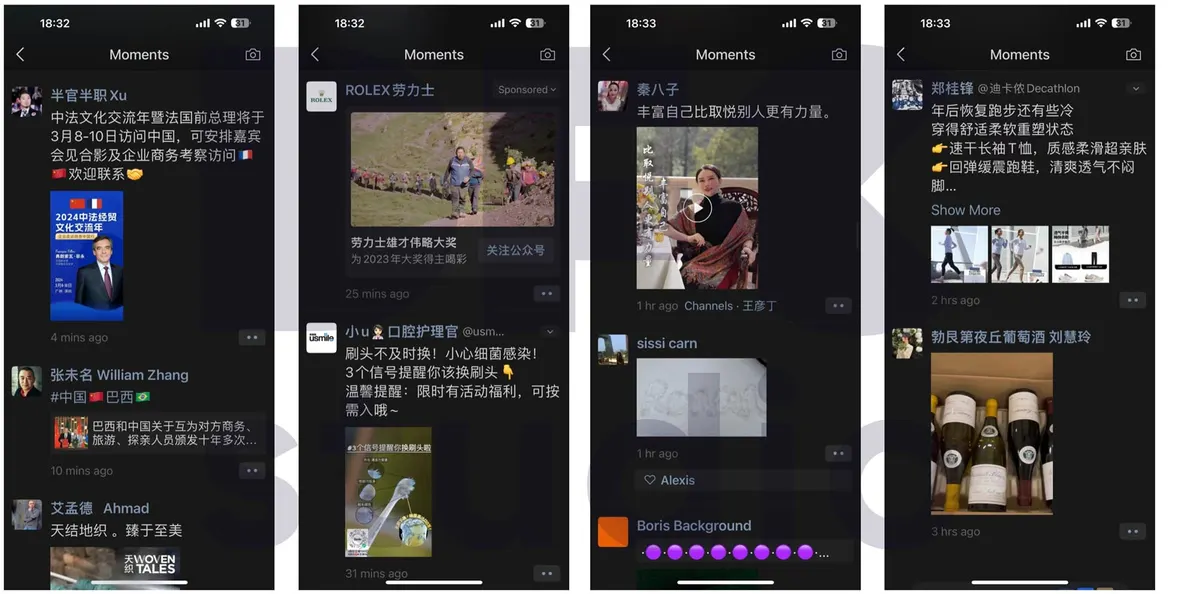
A brand appears there in two ways: through targeted ads, which blend into the feed like a post, and through Customer Moments published by its sales associates on WeCom. Our guide to WeChat advertising details formats and targeting.
WeChat Search: the ecosystem’s search engine
WeChat Search (搜一搜) searches contacts, Official Account articles, Channels videos, Mini Programs, products and the web at the same time. For many Chinese users, it is the first place to look up a brand, even before a search engine like Baidu.
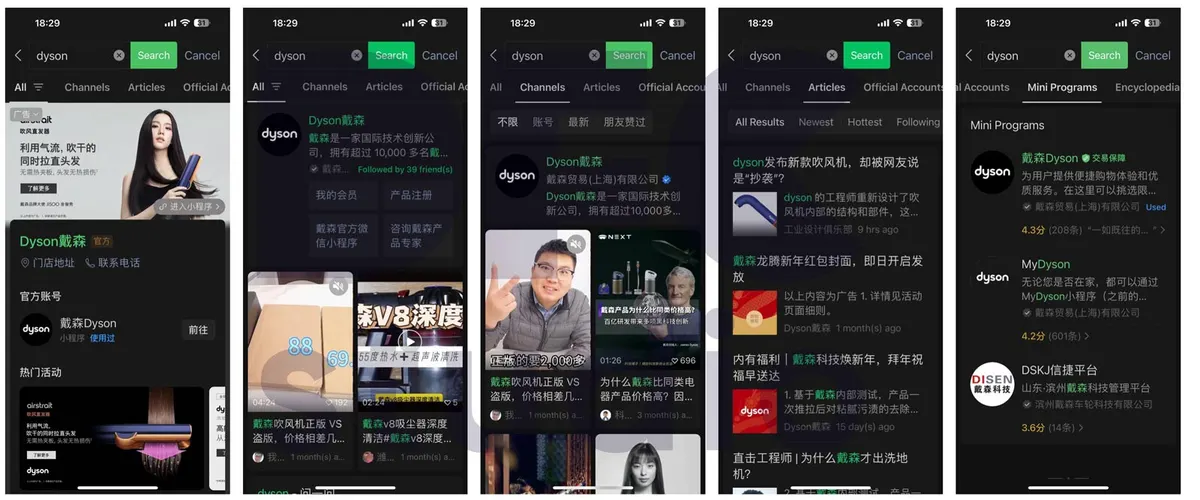
For a brand, being visible in WeChat Search requires a verified Official Account, regular articles on the terms your clients search for, and a presence on Channels. A “brand zone” can also be bought to control the first impression.
What is new in 2025-2026: AI comes to WeChat
Since 2025, Tencent has been building artificial intelligence into the heart of WeChat. In February 2025, search started offering AI-generated answers based on the DeepSeek model. In April 2025, Yuanbao, Tencent’s AI assistant, became available as a contact you can add to ask questions or summarise an article. Tencent then announced plans to build an AI agent into WeChat, able to draw on Mini Programs, content and payments.
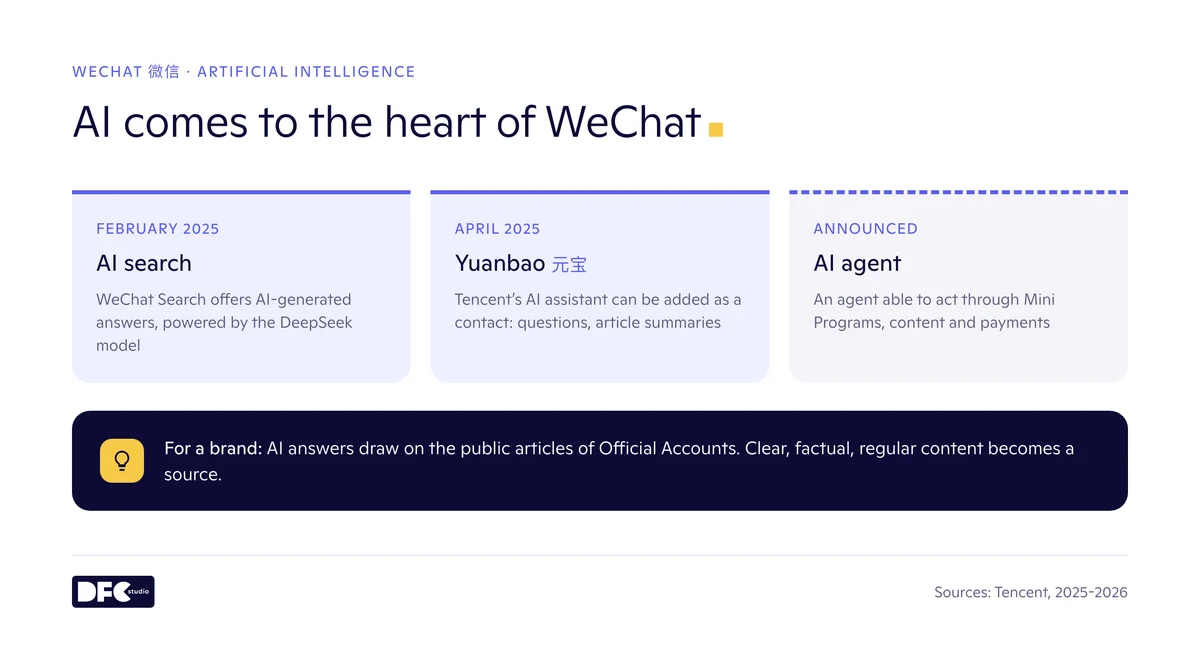
For brands, the consequence is already concrete: answers generated by WeChat’s AI draw on public Official Account articles. Clear, factual and regular brand content therefore also becomes a source for these answers.
Selling and building loyalty: the WeChat store and WeCom
Two tools complete a brand’s setup. The WeChat store (微信小店) lets you sell directly within the ecosystem, from a Channels livestream, an article or a Mini Program; at the end of 2024, it added a gift feature that lets users send a product to a contact in a simple message.
WeCom (企业微信), WeChat’s business version, connects sales associates with their clients in the brand’s name: the relationship no longer depends on an employee’s personal account and survives their departure. More than 14 million companies use it. Read our guide What is WeCom and how brands use it in China.
Using WeChat outside China
WeChat can be downloaded for free from the App Store and Google Play, and you can sign up with a foreign phone number. When creating the account, WeChat may ask an existing user to scan a QR code to confirm the registration: have a contact who already uses the app at hand.
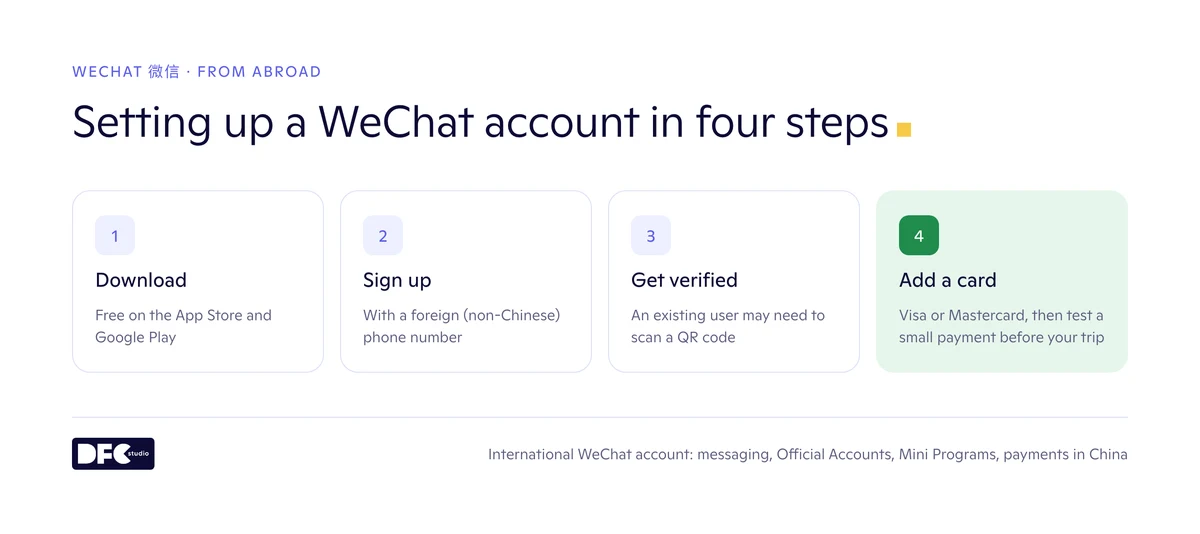
Once your account is set up, you can chat, follow Official Accounts, open Mini Programs and, with an international bank card, pay in China with WeChat Pay. Before a trip, add your card and try a small payment: it is the easiest way to avoid surprises.
Where should a brand start?
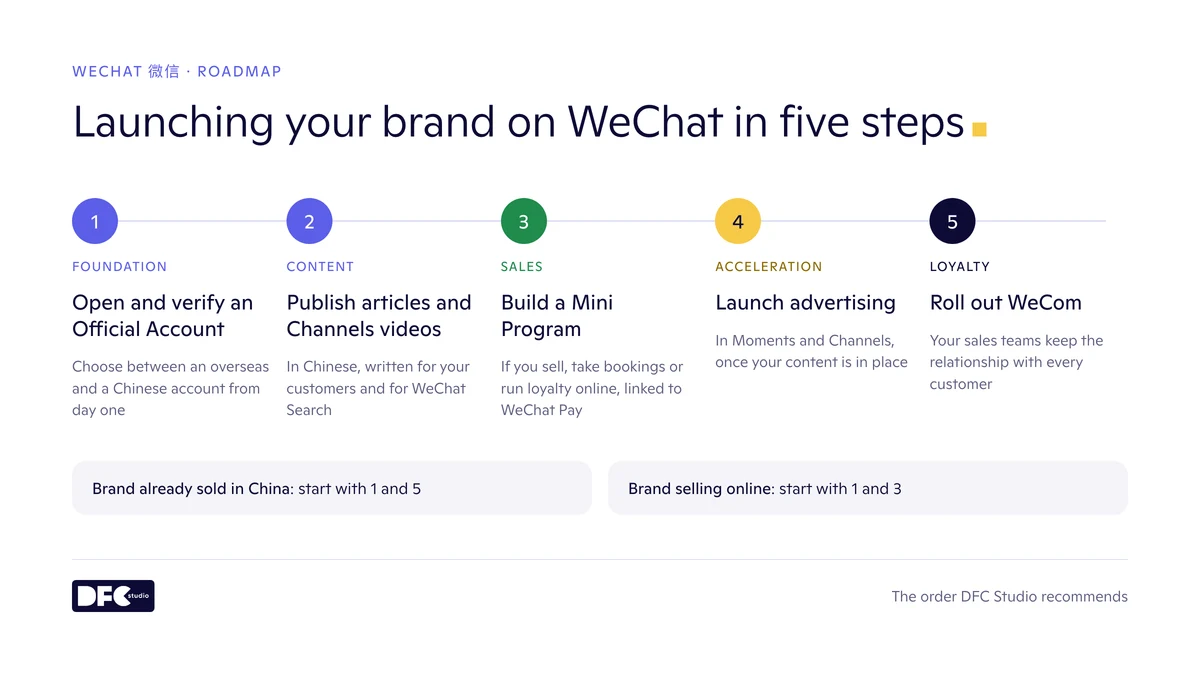
WeChat is not a channel you open in a day. Here is the order we recommend to a brand getting started.
- Open and verify an Official Account, choosing from the start between an international and a Chinese account.
- Publish regularly: useful articles and Channels videos, in Chinese, designed for your clients and for WeChat Search.
- Build a Mini Program if you sell, take bookings or run a loyalty programme online, linked to WeChat Pay.
- Accelerate with advertising in Moments and Channels, once your content is in place.
- Roll out WeCom so your sales teams keep the relationship with each client.
The right pace depends on your sector and your presence in China: a brand already sold through distributors will often start with the Official Account and WeCom, a brand selling online with the Mini Program. Want to talk it through? Contact our team or discover our WeChat agency services.
FAQ
What is WeChat?
WeChat (微信, Weixin in China) is Tencent’s super app, launched in 2011. It brings together messaging, social media, mobile payments, Mini Programs, video and shopping in a single app, used by 1.439 billion people every month.
Is WeChat free?
Yes. Downloading and using WeChat is free. For a brand, Official Account verification is paid, as are advertising and agency services.
Can I use WeChat outside China?
Yes. WeChat is available on the App Store and Google Play and works with a foreign phone number. Registration may require an existing user to confirm it by scanning a QR code.
What is the difference between WeChat and Weixin?
It is the same app in two versions: Weixin for accounts opened with a Chinese number, WeChat for foreign numbers. Features, terms of use and privacy policies differ.
Does WeChat Pay work with a foreign card?
Yes. Foreign users can link a Visa or Mastercard to WeChat Pay to pay in China, in store and online.
Can a foreign company open a WeChat Official Account?
Yes, with an international Official Account, without a Chinese entity. This account cannot later be converted into a Chinese account, and some features such as payments require a Chinese business licence.
What is the difference between a subscription account and a service account?
A subscription account can send one broadcast a day to its followers: it suits brands that publish a lot. A service account sends four broadcasts a month, but gives access to advanced features such as payments.
What is the difference between WeChat and WeCom?
WeChat is the consumer app. WeCom (企业微信) is its business version: it lets a brand’s teams talk to their clients on WeChat in the company’s name.

Thibault has been living in Beijing since 2014 and has quickly established himself as one of the leading international digital experts in China. With his extensive expertise, he assists large corporations, institutions, and high-end brands in their digital development by offering strategic solutions tailored to the Chinese market.