Founded in 1998, the platform has risen to become the second-largest B2C online retail site in China, thanks to its unique model, ultra-efficient logistics and high level of service. But how does JD.com really work? Who are its competitors, and what innovations does it offer? This article takes you to the heart of the JD ecosystem, from the company's origins to how it operates today.
What Is JD.com?
JD.com, often called Jingdong, was founded by Richard Liu (Liu Qiangdong) in 1998 as "Jingdong Multimedia", a physical store selling electronic products. The move to e-commerce came in 2004, and the platform has kept growing ever since. JD.com no longer discloses its user count, but it had around 610 million monthly active users in September 2025 according to QuestMobile (+14.8% year on year). In Q2 2026, its quarterly revenue reached 346.4 billion yuan.
Unlike Alibaba, which acts mainly as a marketplace, JD.com is based on a B2C (business-to-consumer) model, which means the company manages much of its inventory and logistics itself. This approach gives it better traceability of goods, guaranteeing Chinese consumers authentic products and extremely fast delivery times.
JD.com stands out for its complete control of the supply chain. Rather than simply connecting buyers and sellers, as Alibaba does with Taobao and Tmall, JD owns its warehouses and uses an advanced logistics fleet: JD Logistics. This subsidiary, created in 2017 with significant capital, employs more than 300,000 delivery staff and uses cutting-edge technologies such as drones and autonomous vehicles to deliver in 24 hours or less in some urban areas.
Beyond e-commerce, JD.com has diversified into JD Health (online medical services and sales of pharmaceutical products) and JD Fintech (payment solutions and financial services). These extensions help JD build loyalty among its Chinese customers by offering an integrated experience that goes well beyond online retail.
How Does JD.com Work?
For Buyers
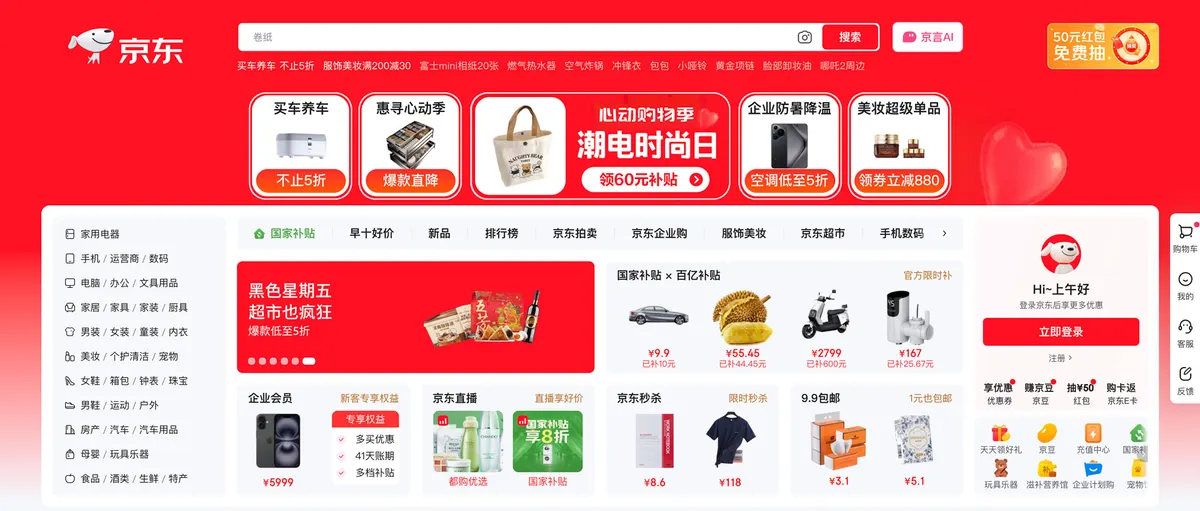
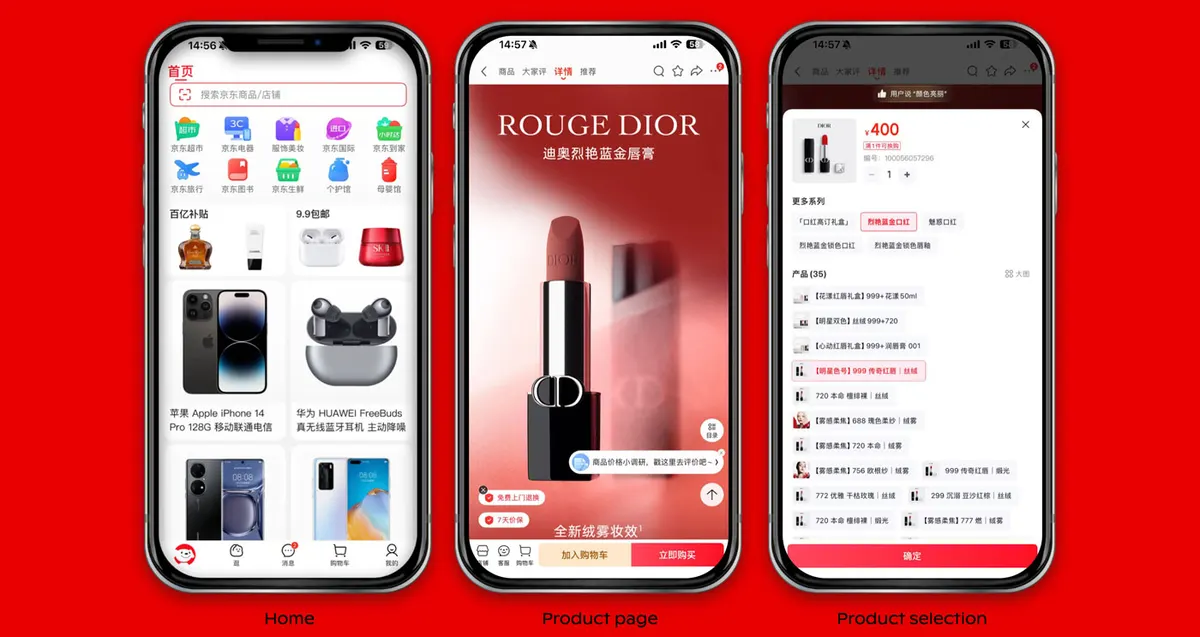
The user experience on JD.com is designed to be simple and fast. The platform offers an intuitive interface on desktop and through a very popular mobile app. Chinese consumers can find millions of products there, from electronics and fresh food to clothing, children's products and luxury items.
For Sellers
JD.com also lets third-party businesses sell on its platform, although this model is less dominant than at Alibaba. Sellers must meet strict quality and customer service criteria, but in return they get access to a massive customer base and optimized logistics. JD even offers cross-border e-commerce services through JD Worldwide, making international sales to China easier.
Jingdong Logistics and Delivery
Thanks to its dense logistics network and ultra-fast direct delivery services, JD often offers same-day or next-day delivery in major Chinese cities.

This level of service is particularly appreciated by China's urban population. The platform accepts various payment methods, including WeChat Pay, Alipay, bank cards and cash on delivery.
Innovation and Technology
JD relies heavily on technology to stay competitive. The platform uses artificial intelligence to personalize product recommendations and optimize inventory management. Its automated warehouses, equipped with robots, process millions of orders a day with extreme accuracy.
JD.com vs. Alibaba
Who dominates Chinese e-commerce? Alibaba (through Taobao and Tmall) remains the undisputed leader of e-commerce in China with a market share of about 50%, compared with 20% for JD.com. However, JD differentiates itself with its B2C model, which guarantees better-quality, authentic products and more reliable delivery. JD is particularly appreciated for its electronic products and its partnerships with international luxury brands such as Louis Vuitton (an exclusive agreement with the LVMH group). Alibaba, on the other hand, offers a wider variety of products through its marketplace approach, but with less control over third-party sellers.
Challenges and Future Prospects
Despite its impressive growth, JD.com faces several challenges. Competition remains fierce, both with Alibaba and with emerging platforms such as Pinduoduo. JD is also looking to expand internationally with JD Worldwide, particularly in Southeast Asia and Europe.
However, its costly logistics model could make this expansion complex. In France, the group has opened a subsidiary, JINGDONG DEVELOPMENT FRANCE, a sign of its European ambitions.
JD.com (Jingdong) in France and Europe
JD.com is not limited to the Chinese market. For several years, the group has been expanding in Europe, making it a player to watch closely, including from France.
JD in Europe: A Tangible Presence
→ JD has opened warehouses and logistics hubs in Europe, notably in the Netherlands, to shorten delivery times to European consumers.
→ The group has multiplied partnerships with European retailers and brands in electronics, fashion and consumer goods.
→ JD Logistics, the group's logistics arm, is building up its capacity on the continent to serve both cross-border trade with China and local distribution.
What This Means for a French Brand
For a French brand, JD represents two distinct opportunities:
→ Selling in China: open a store on JD or JD Worldwide to reach hundreds of millions of Chinese consumers, with the guarantee of authenticity that has made the platform's reputation.
→ Relying on JD's logistics in Europe: for brands already involved in cross-border trade, JD's European infrastructure can streamline flows between France and China.
Can JD Be Accessed From France?
The JD.com app and website can be accessed from France, but the interface is still mainly in Chinese and most sellers prioritize delivery within China. For a brand that wants to sell on JD, working with a specialist agency remains the most direct way to open and run an account.
Conclusion
JD.com has become a giant of Chinese e-commerce thanks to its integrated model, ultra-fast logistics and technological innovations. Although it remains behind Alibaba in market share, its B2C strategy and commitment to quality set it apart.
In the future, JD will have to keep innovating, particularly through effective advertising campaigns, to conquer new markets and win over more Chinese consumers. One thing is certain: in the world of e-commerce, JD.com is a player to watch closely.
Interested in selling on the Chinese market? Feel free to contact us: we work closely with the Jingdong teams based in Paris and in China.
OUR EXPERTISEE-commerce agency in China
Thibault has been living in Beijing since 2014 and has quickly established himself as one of the leading international digital experts in China. With his extensive expertise, he assists large corporations, institutions, and high-end brands in their digital development by offering strategic solutions tailored to the Chinese market.