Double 11 (双十一) 2026 has just ended. The verdict: the world’s biggest shopping festival grew by only 4.8%, but that figure hides something far more interesting for a foreign brand: hundreds of niches grew by more than 50%. Here is where the real growth is in China, and how to position your brand there.
THE 30-SECOND SUMMARY
→ 1,776.4 billion yuan in sales (GMV) from 7 October to 11 November 2026, up 4.8% year on year (Syntun).
→ Growth is slowing: +14.2% in 2025. Only instant retail is accelerating, at +33%.
→ Tmall counted 228 niches growing by more than 50%, 117 of them by more than 100%.
→ For a foreign brand: target a measured niche, sell a product-plus-service, and build content before conversion.
What is Double 11?
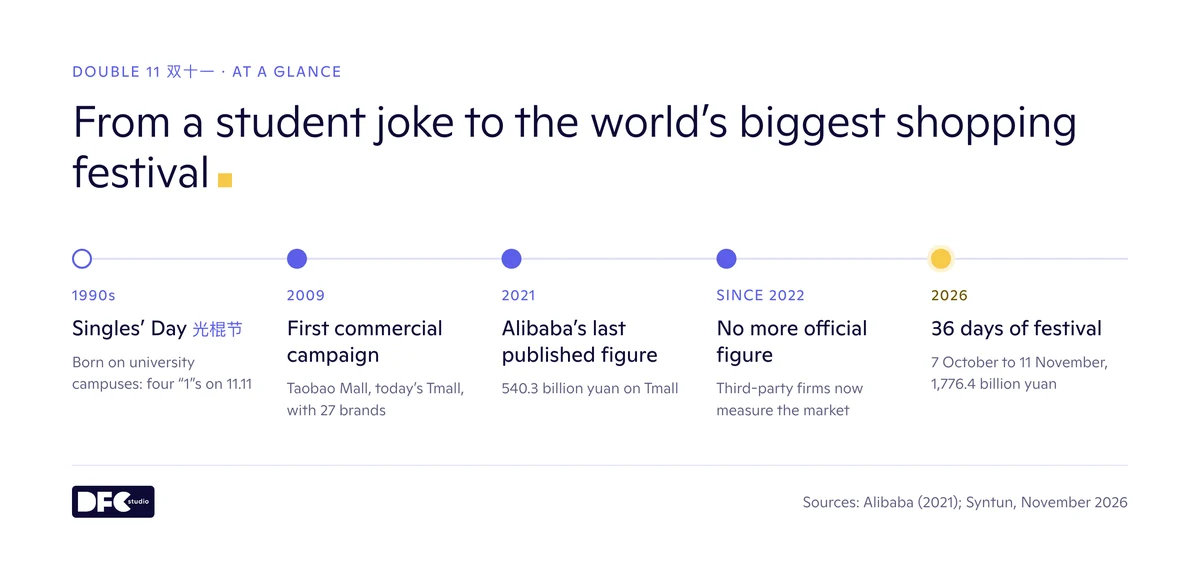
Double 11 is named after its date, 11 November (11.11). It started on Chinese university campuses in the 1990s as “Singles’ Day” (光棍节), a nod to the four “1”s in the date, and became a commercial event in 2009, when Taobao Mall, today’s Tmall, ran a day of promotions with 27 brands.
It has since become the world’s biggest shopping event. Every platform takes part (Tmall, JD, Pinduoduo, Douyin, Kuaishou, Xiaohongshu), and the single day has stretched into a season of more than a month: pre-sales, cross-store discounts, platform subsidies and livestream selling.
READ ALSOWhat is Double 11? The full story of the festival
Growing your brand in China? Meet our e-commerce agency in China: a Franco-Chinese team in Beijing, from strategy to campaigns.
A giant that no longer publishes its sales
Double 11 is still the world’s biggest shopping event, but it has changed. Since 2022, neither Alibaba nor JD.com has published its total sales. Tmall reports concrete volumes, JD reports on its services, Douyin on its merchants. Nobody discloses the overall figure any more.
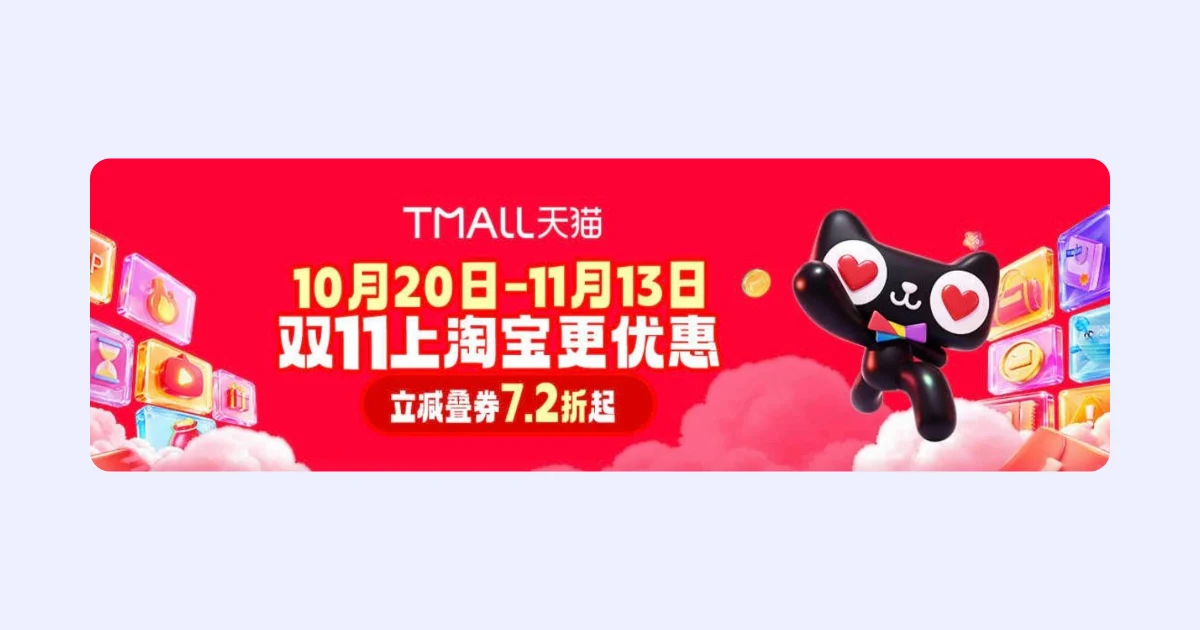
To measure the market, we therefore rely on Syntun (星图数据), China’s benchmark third-party data firm. Its report of 12 November 2026 covers the full festival period, from 7 October to 11 November. That is the basis we use here, cross-checked against the platforms’ official reports. Each platform also has its own calendar: Tmall and Taobao, for instance, announced a period from 20 October to 13 November.
Double 11 2026 key figures
| Indicator | Result | Source and period |
|---|---|---|
| Total GMV | 1,776.4 billion yuan (about USD 264 billion), +4.8% | Syntun, 7 Oct – 11 Nov 2026 |
| Traditional e-commerce (Tmall, JD, Pinduoduo, Douyin, Kuaishou) | 1,679 billion yuan, +3.7%. Tmall 1st, JD 2nd, Douyin 3rd | Syntun, full period |
| Instant retail (即时零售: Meituan, JD Seconds, Taobao Flash) | 89.1 billion yuan, +33% | Syntun, full period |
| Community group buying | 8.3 billion yuan, −7.4% | Syntun, full period |
| Slowing growth | +14.2% in 2025, +4.8% in 2026 | Syntun |
| Trend since 2023 | 1,140, then 1,440, then 1,700 billion yuan (2023 to 2025) | People’s Daily (different scope from Syntun) |
GMV (gross merchandise value) is still rising, but the pace has clearly slowed. The festival is no longer a rocket: it is mature consumer infrastructure.
The big categories: a solid base, but locked
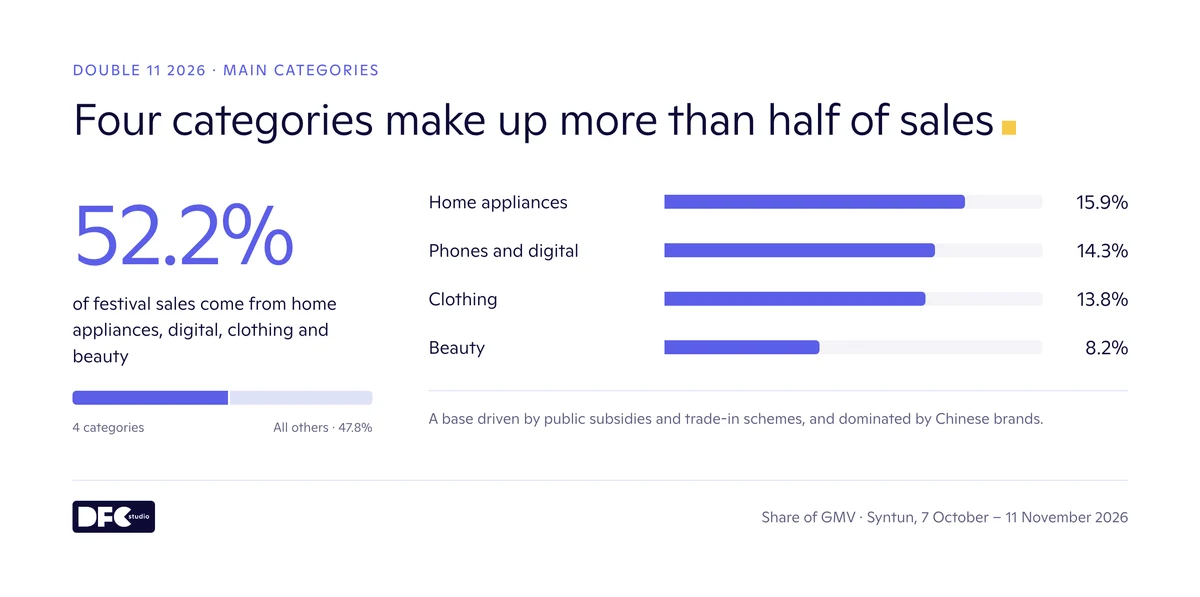
Home appliances (15.9% of sales, Syntun), phones and digital (14.3%), clothing (13.8%) and beauty (8.2%) together make up more than half of the market.
But this base is driven by public subsidies and trade-in schemes: subsidised phone sales grew more than ninefold on Tmall, and Apple grew by 400% on day one thanks to its new iPhone. Beauty is dominated by Proya (珀莱雅), a Chinese brand that topped Tmall’s ranking for the fourth year running, and on JD more than 2,000 home appliance and home brands doubled their sales. For a foreign brand, this is no longer where the growth is.
Niches above +10%: where the growth is
On its first day, Tmall counted 228 new niches growing by more than 50%, 117 of them by more than 100%. Here are the most relevant ones for a foreign brand.
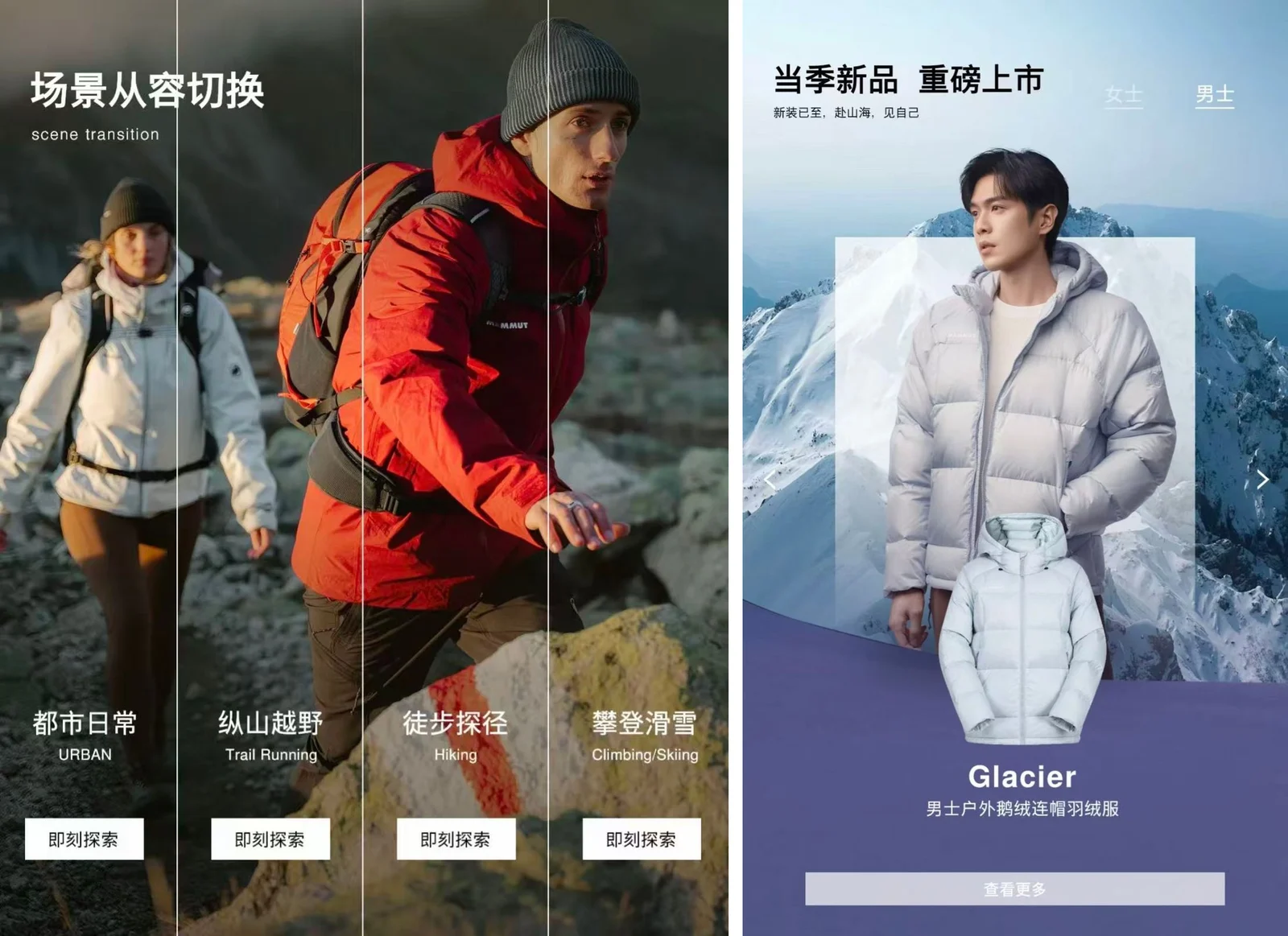
1. Technical outdoor: proof that a specialised European brand can win in China
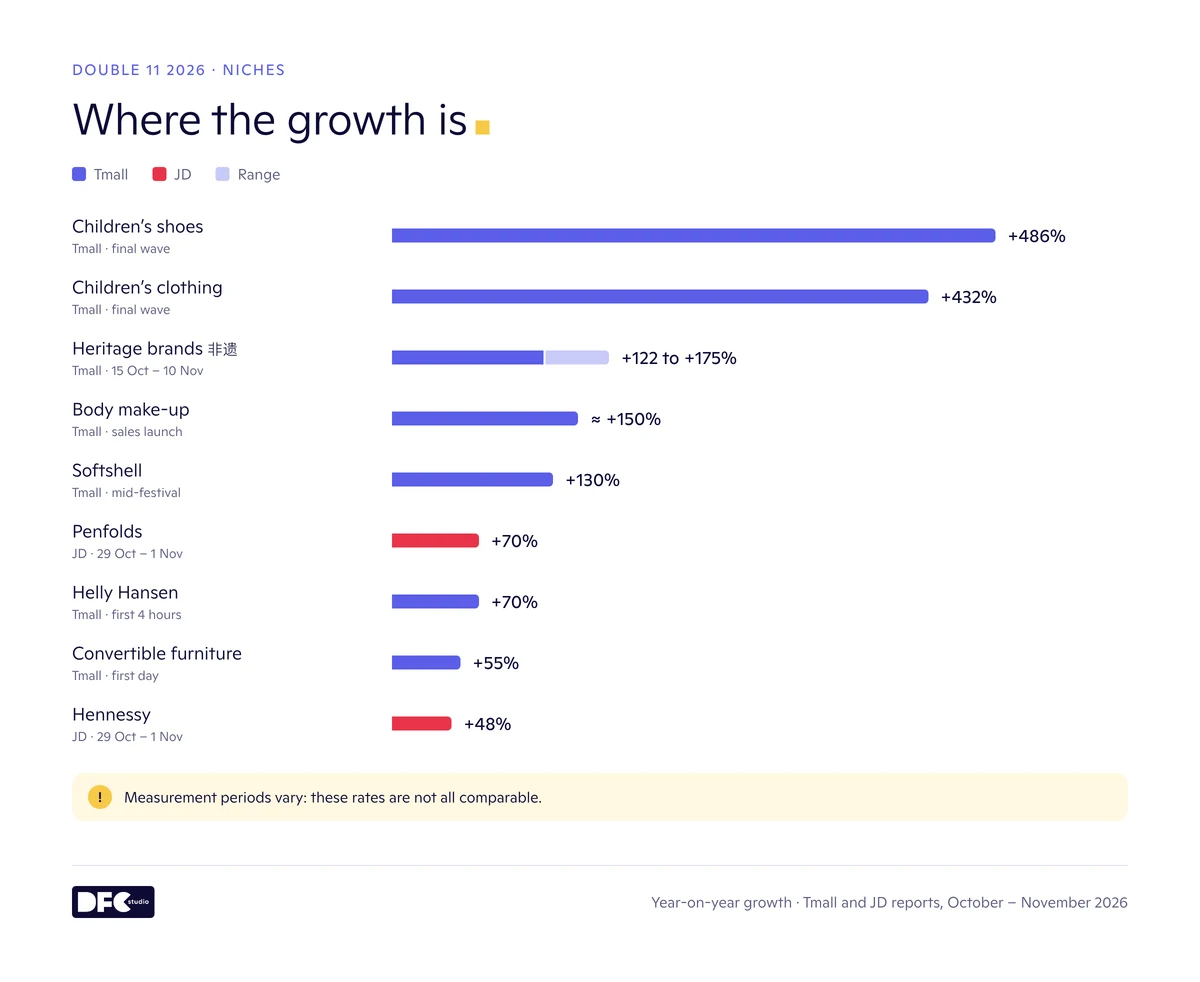
The figures. On Tmall, halfway through the festival, softshell jackets were up more than 130%, trail running shoes more than 90%, casual outdoor clothing more than 70% and casual outdoor footwear more than 50%. On JD, 20 outdoor categories doubled their sales, including trail running and windbreakers. European brands are posting strong double-digit growth: Salomon, Helly Hansen (more than +70% in 4 hours on Tmall) and Mammut, whose first hour of sales beat its whole day in 2025.
The driver. Chinese consumers have taken up outdoor sports for good. They invest in technical gear, and they trust the European houses that have carried this expertise for decades.
The opportunity. A foreign outdoor brand does not need to slash prices to exist. It needs to be on Tmall with a flawless technical story, run field content on Douyin and Xiaohongshu, and target the precise categories (trail running, softshell, windbreakers) where measured demand is booming.
2. High-end beauty, body care and fragrance: the big houses hold, body care is open ground
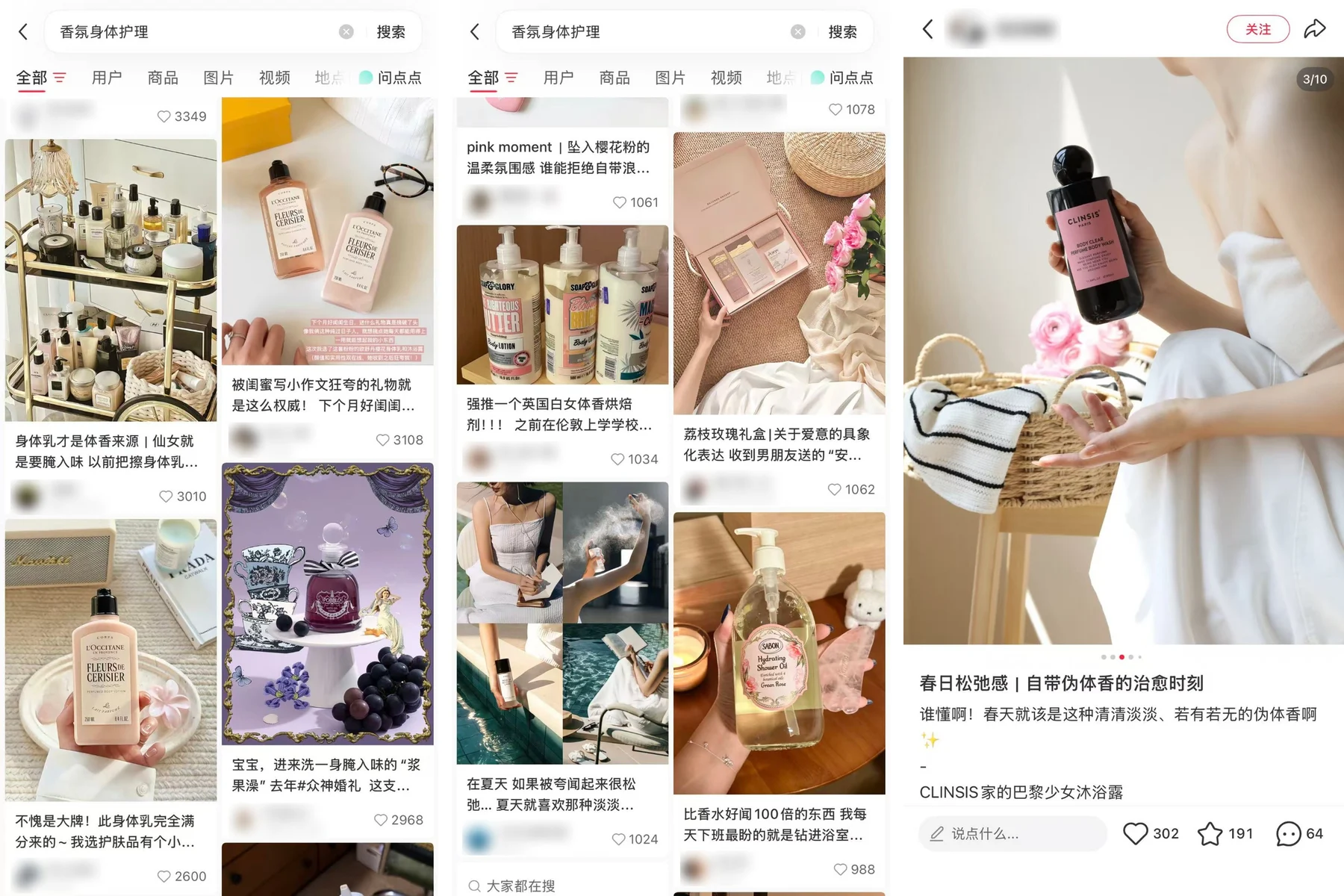
The figures. When sales opened on Tmall, SkinCeuticals, SK-II and Helena Rubinstein all posted double-digit growth. Body care and body cleansing grew by more than 10%, and body make-up by almost 150% (Tmall, source 青眼情报). In fragrance, the Chinese scented-care brand 颂境 grew by more than 400% (Tmall, sales launch).
The driver. International prestige beauty remains a mark of quality for Chinese consumers. But the real momentum is in body care and fragrance, where no big house has locked the market yet and Chinese players are rising fast.
The opportunity. For a European beauty or fragrance house, body care is today the most profitable way in: strong measured growth, limited international competition, and a specialist image still up for grabs.
3. Wines and spirits: cognac and branded wines grow, entry-level wine stalls
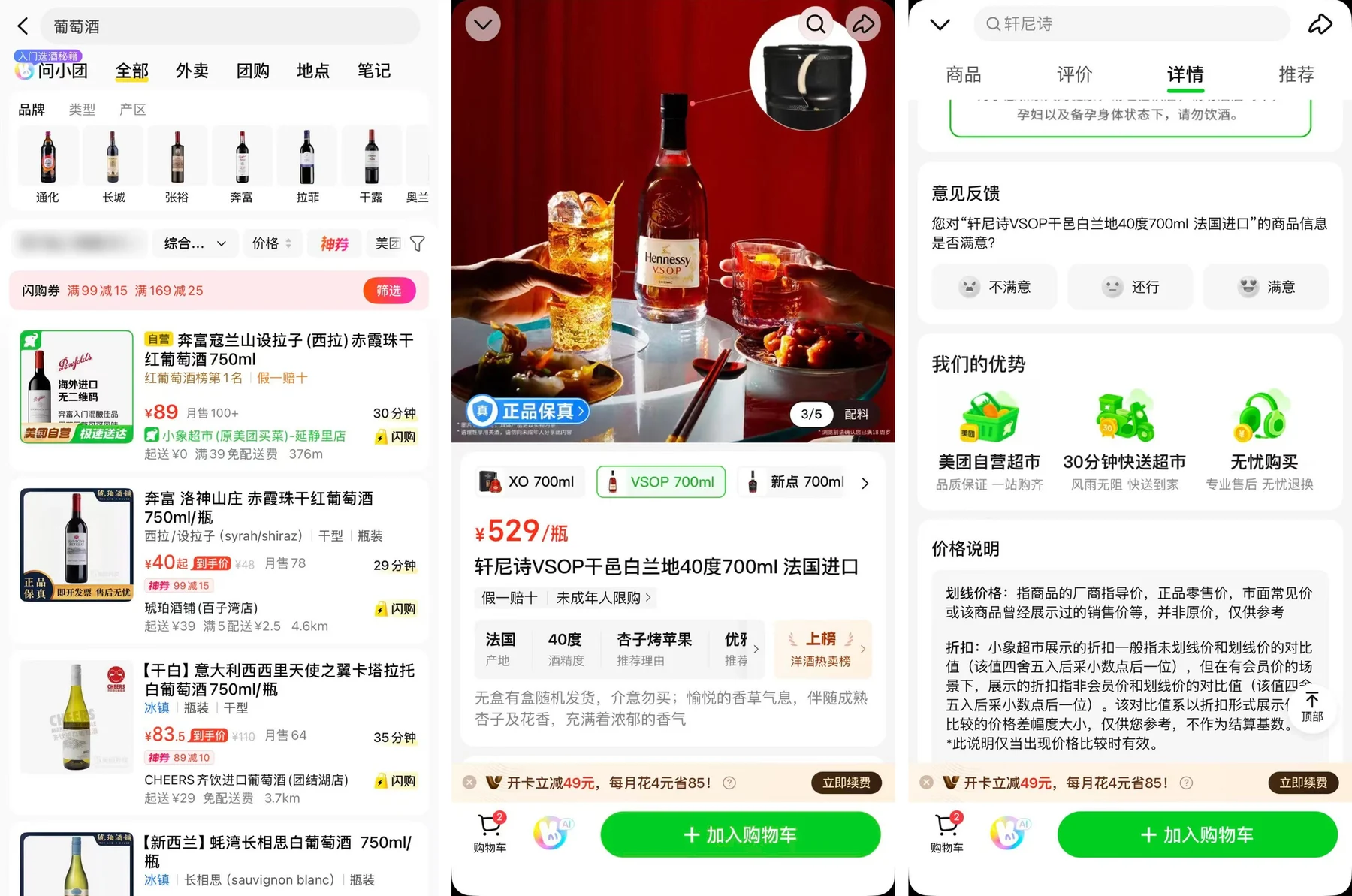
The figures. Alcohol sales grew by 25% on JD over the full festival (8 October to 11 November). Between 29 October and 1 November, Hennessy was up 48% and Penfolds 70% on JD. On Tmall, as of 25 October, alcohol sold through instant delivery was up 265%. An essential nuance: wine overall is flat or slightly down depending on the merchant, and consumers no longer respond to slashed prices.
The driver. Demand is polarising: strongly identified spirits (cognac) and well-established branded wines are growing, while generic wine is losing its appeal. Instant delivery changes the game: alcohol becomes an impulse buy, for dinner tonight, not for the cellar.
The opportunity. A spirits house or a wine brand should build a two-layer setup: classic distribution that tells the heritage story, and a presence in instant retail that captures the last-minute purchase. Aggressive promotions backfire: consumers ignore them.
4. Home and lifestyle: consumers buy convenience and service
The figures. From day one on Tmall, convertible furniture was up 55% and semi-custom furniture 49%, driven by delivery, installation and trade-in services. 100-inch TVs were up 30%.
The driver. In China, value no longer lies only in the product: it lies in the service that comes with it. Furniture that installs effortlessly is worth more than perfect furniture you have to assemble yourself.
The opportunity. A European home or lifestyle brand should design its China offer as a product plus service: tracked delivery, installation, trade-in. It is often the deciding factor, more than design or price.
5. Pets: a move upmarket that big houses are already exploiting
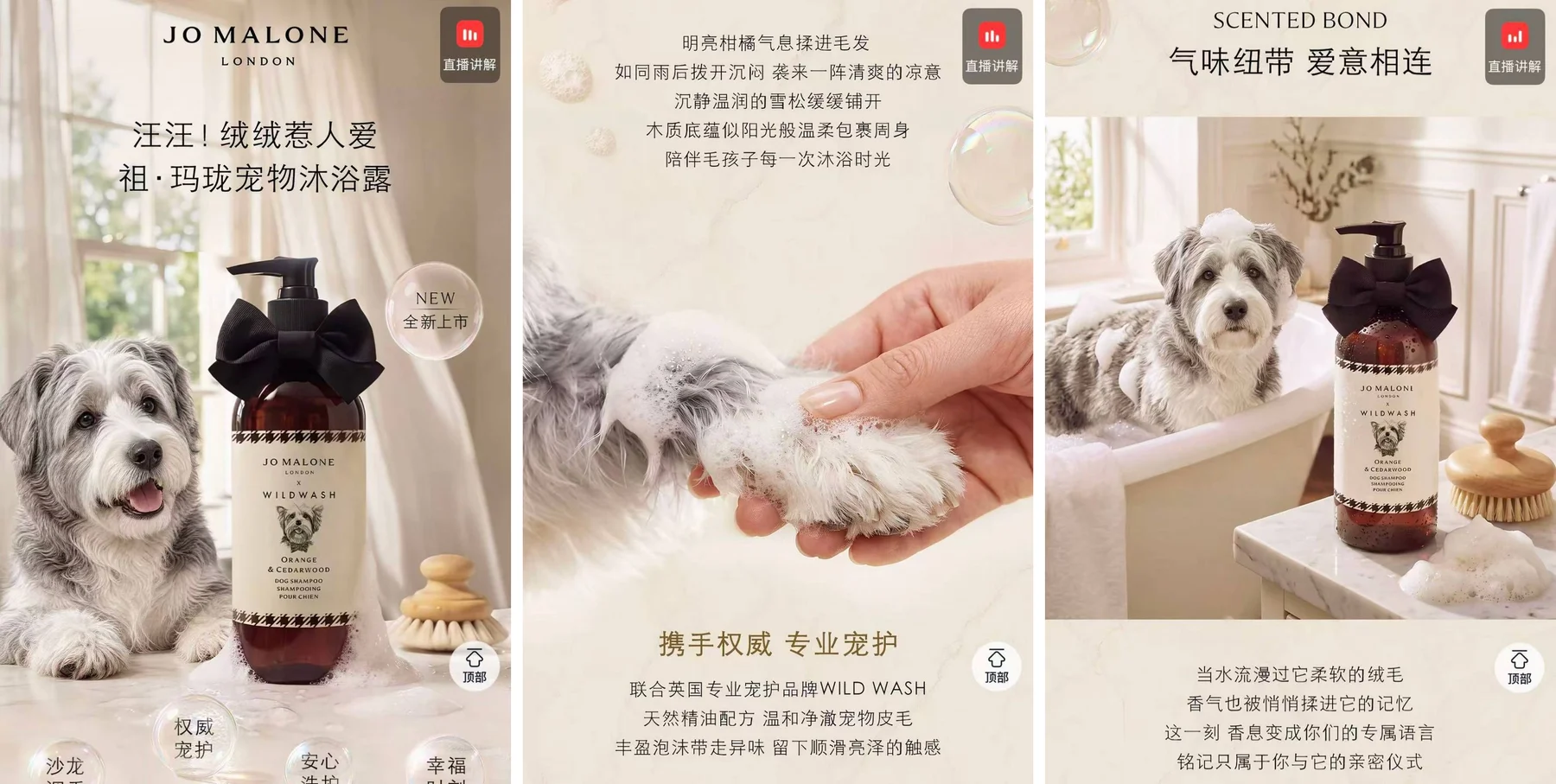
The figures. On Douyin, the number of pet brands selling more than 100 million yuan doubled (+100%), and 95 brands from other sectors entered this market. Jo Malone London now sells a 200-yuan dog shampoo, created with the British pet-care brand Wildwash. Pet wipes from the brand 德佑 were up more than 160% on Tmall.
The driver. Pets have become members of the urban family, with a beauty and wellness budget to match. This “humanisation” of pets pushes consumers towards premium products, and the big houses understood it before the specialists.
The opportunity. For a beauty, fragrance or lifestyle brand, a pet-care extension is a niche with little foreign competition and high added value. The Jo Malone move shows that consumers are ready to pay 200 yuan for a dog shampoo, as long as the brand puts its name and its world on it.
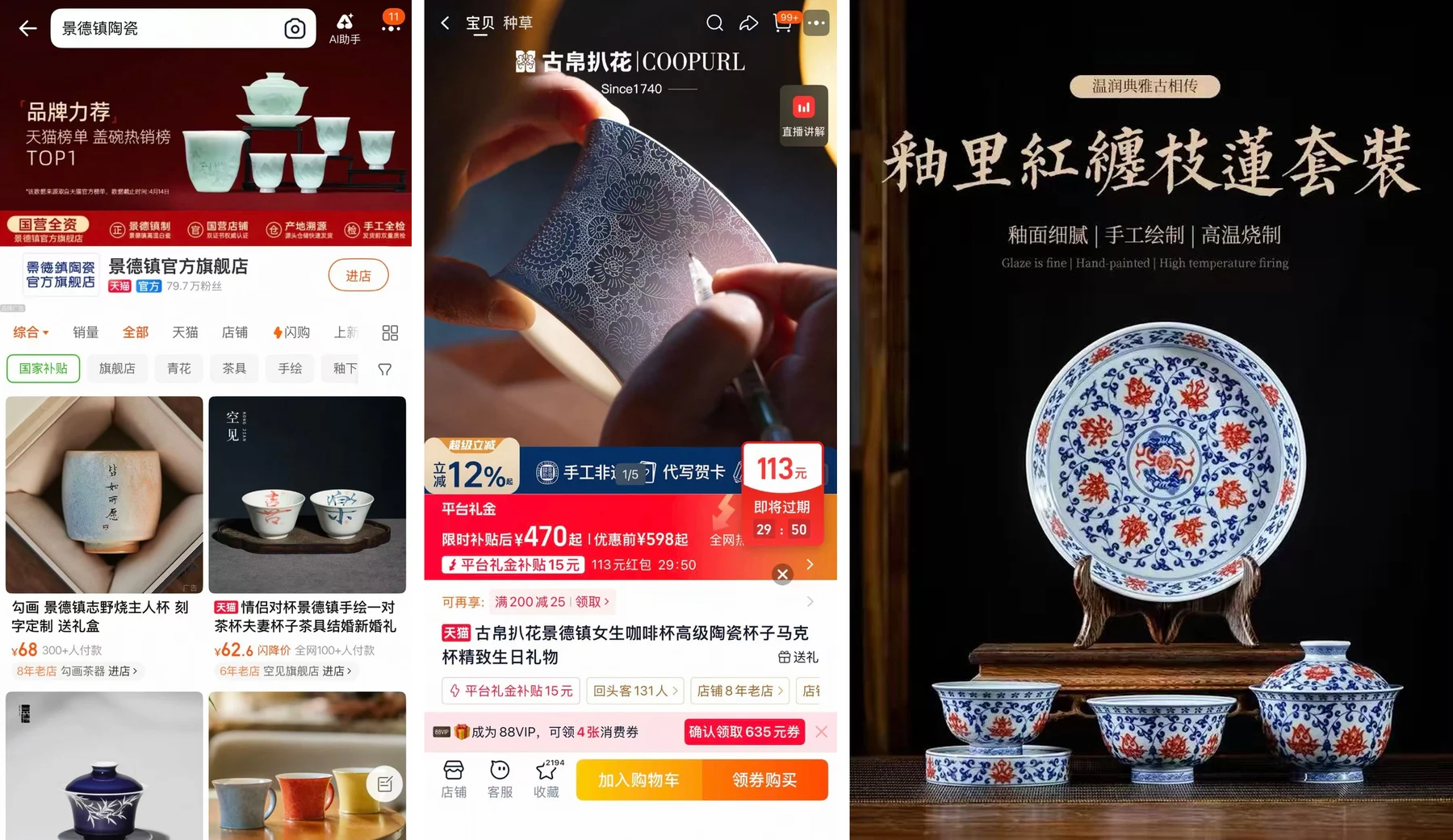
6. Heritage and craftsmanship: a demand for cultural stories that a foreign brand can feed
The figures. On Tmall, from 15 October to 10 November, the official stores of heritage brands (非遗, intangible cultural heritage) grew by 122% to 175%.
The driver. Part of Chinese demand is looking for products with a story, a technique, a lineage. Chinese heritage benefits directly, but the mechanism is universal: documented craftsmanship creates value.
The opportunity. A century-old foreign brand, a manufacture, a house with a history: its heritage is a commercial asset in China, as long as it is told through content (Xiaohongshu, Douyin, Bilibili), not only on a product page.
7. Three trend signals to watch
- Children. Children’s clothing (+432%) and children’s shoes (+486%) on Tmall, during the final promotional wave: parents are spending with confidence.
- Consumer AI. AI PCs, glasses and cameras grew by more than 100% on JD over the full period.
- Services. More than 300 million orders on JD: housekeeping +550%, health check-ups +300%, aesthetic medicine up 3.6 times; on Douyin, creative workshops grew by 890%. Experience spending is the next frontier.
A three-part reading
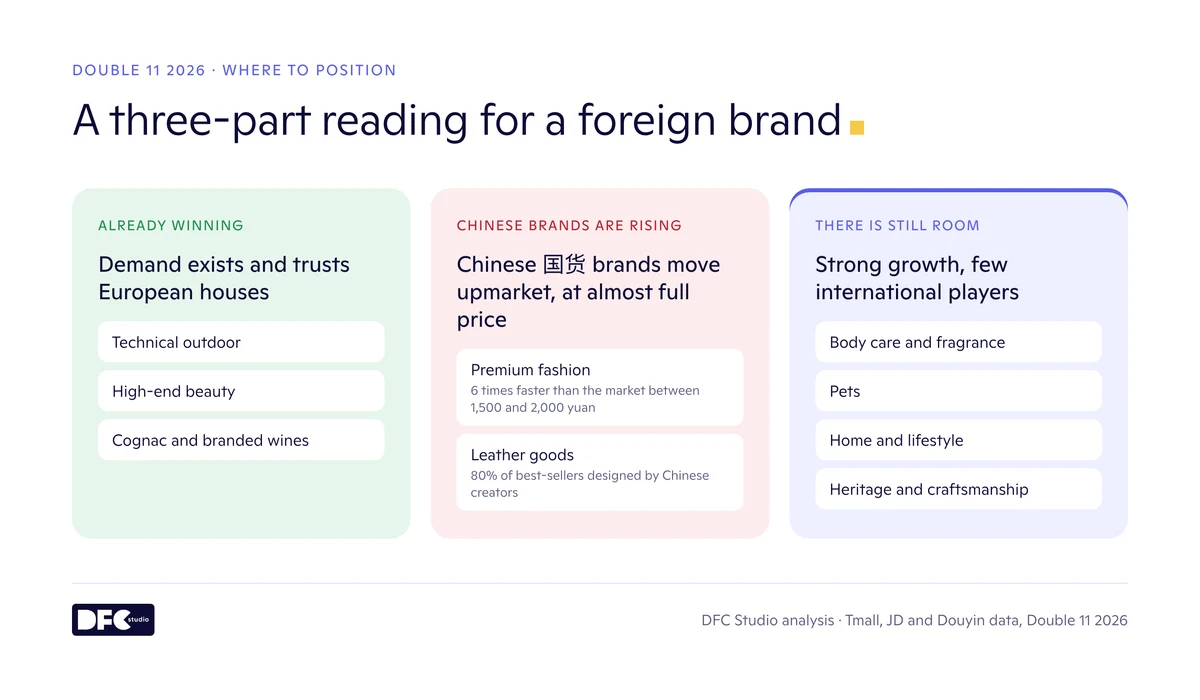
Where foreign brands are already winning: technical outdoor, high-end beauty, spirits. Demand exists and is measured, and consumers trust European houses.
Where Chinese brands are moving upmarket and becoming a threat: premium fashion and leather goods. In the 1,500 to 2,000 yuan bracket, long dominated by international accessible premium brands, Chinese brands (国货) are growing six times faster than the market on Tmall (January to October). 之禾 (Icicle) is up 99.55% in sales and 110.11% in volume, at almost full price. In leather goods, 80% of best-sellers above one million yuan come from Chinese designers.
Where there is still room: body care and fragrance, pets, home and lifestyle, heritage. Strong measured growth, and international players are still rare.
Tmall, JD, Douyin, Xiaohongshu: where to activate these niches
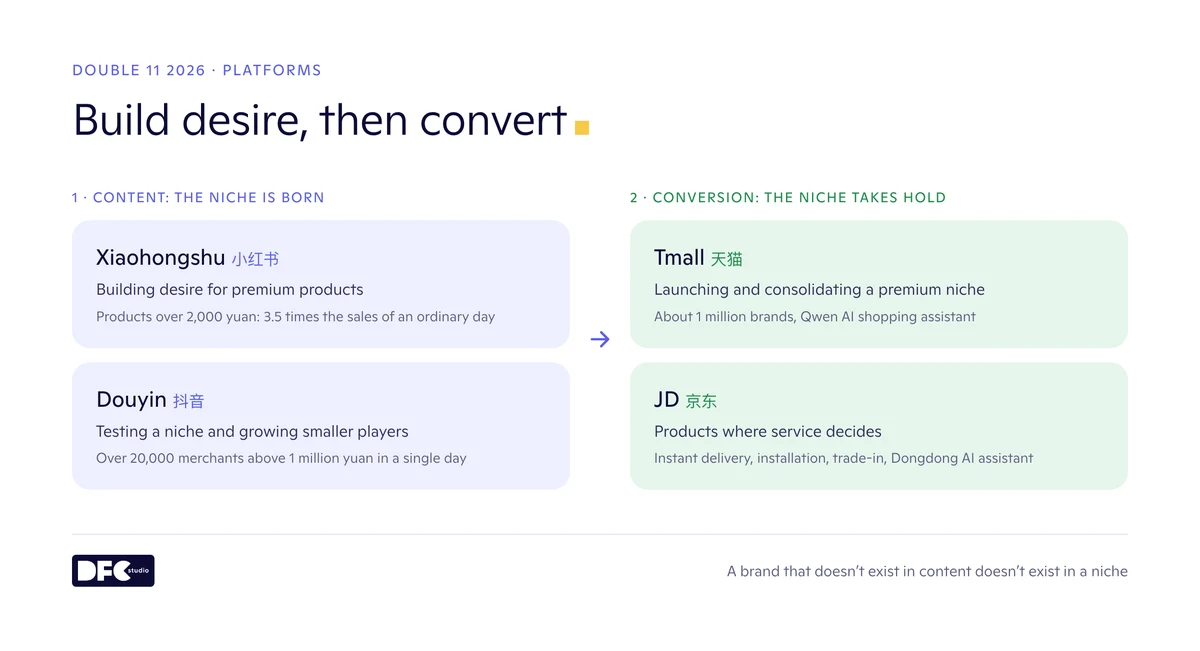
- Tmall is the reference platform to launch a premium niche: about 1 million participating brands, official instant discounts and an AI shopping assistant (Qwen). It is where the niches described above are measured.
- JD is the natural choice for products where service decides: instant delivery, installation, trade-in, and the “Dongdong” AI assistant.
- Douyin is the growth engine for smaller players and emerging categories: more than 20,000 merchants passed 1 million yuan in sales in a single day. Ideal to test a niche before establishing it on Tmall.
- Xiaohongshu remains the showcase for premium brands: during the festival, its products priced above 2,000 yuan reached 3.5 times the sales of an ordinary day (a comparison with a normal day, not annual growth). It is where desire is built before the purchase.
Five lessons for a foreign brand in China
- Don’t judge the Chinese market by overall GMV. +4.8% hides hundreds of niches at +50% and more. Growth is fragmented: good news for a specialised brand.
- Target a measured niche, not a whole category. Entering “beauty” or “fashion” in 2026 means taking on Proya and the 国货 giants with their budgets. Entering body care, trail running or semi-custom furniture means going after proven demand with manageable competition.
- Build a product plus service, not just a product. Delivery, installation, trade-in, advice: it is often the deciding factor. On JD, services delivered the big numbers of this edition.
- Stop slashing prices. Consumers no longer respond to aggressive promotions, in wine as elsewhere. 之禾 sells at almost full price and doubles its sales: trust beats discounts.
- Invest in content before conversion. Niches are born on Douyin and Xiaohongshu and consolidate on Tmall and JD. A brand that does not exist in content does not exist in a niche.
VIEW FROM THE FIELD
“Chinese consumers have changed profoundly. They have become pragmatic, almost methodical: they compare, weigh the arguments, then choose the best option for their budget. A foreign label is no longer enough to convince them; what decides them is clear, verifiable benefits. If your product is the best in its category and price range, and you can prove it, you have won.”
 Thibault Alcorani
CEO of DFC Studio, Beijing
E-COMMERCE AGENCY IN CHINA
Which niche should your brand launch in China?
From Beijing, DFC Studio helps brands choose their niche, their story and their activation order across Tmall, JD, Douyin and Xiaohongshu.
Let’s talk about your project →FAQ
What were Double 11 2026 sales?
According to Syntun, a third-party data firm, total GMV reached 1,776.4 billion yuan (about USD 264 billion), up 4.8% year on year, over the period from 7 October to 11 November 2026. Neither Alibaba nor JD.com has published an official figure since 2022.
What is Double 11?
Double 11 (双十一) is China’s shopping festival on 11 November. It started as a student Singles’ Day and became a commercial event in 2009 on Taobao Mall (Tmall). It is now the world’s biggest shopping event, spread over more than a month.
Which niches are growing fastest in China right now?
According to Tmall, JD and Douyin reports for Double 11 2026: technical outdoor (softshell up 130% on Tmall), body care (body make-up up almost 150%), branded spirits (Penfolds up 70% on JD), premium pet products and semi-custom furniture (+49%).
Is Double 11 still profitable for a foreign brand?
Yes, but no longer in the big categories, which are saturated and dominated by Chinese brands. Profitability lies in growing niches, where a specialised foreign brand enjoys an image of expertise that is still rare.
Which platform should I choose to launch a premium brand in China?
Xiaohongshu and Douyin to build desire and test demand, Tmall to consolidate the niche, JD if your product relies on service (delivery, installation). The activation order depends on your category.
Conclusion: Double 11 has changed, and so should your strategy
Double 11 2026 is no longer a record figure announced one night in November. It is mature consumer infrastructure worth 1,776 billion yuan, where growth has moved into niches. For a foreign brand, the question is no longer “should we be in China?”, but “which niche, with which story, and in which activation order?”. That is exactly the work we do from Beijing with the brands we support. To discuss it, get in touch.
OUR EXPERTISEE-commerce agency in China
Thibault has been living in Beijing since 2014 and has quickly established himself as one of the leading international digital experts in China. With his extensive expertise, he assists large corporations, institutions, and high-end brands in their digital development by offering strategic solutions tailored to the Chinese market.